
Although stray bullet incidents are likely underrepresented and often misidentified, evidence supports the fact that deaths are rare compared to the number of bullets flying.
Stray bullets end lives and terrorize communities all over the globe. Despite limited research, news articles provide valuable insight into the effects of stray bullets on individuals and communities.
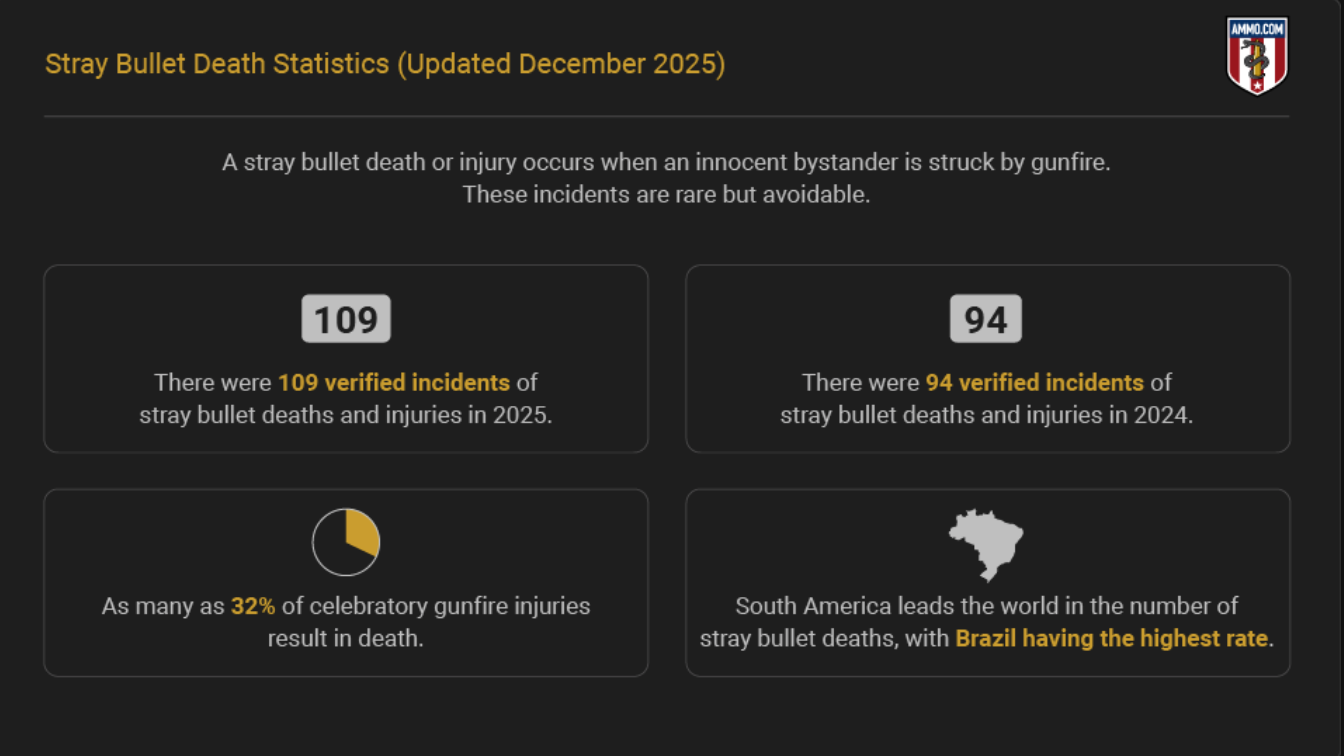
Report Highlights: A stray bullet death or injury occurs when an innocent bystander is struck by gunfire. These incidents are rare but avoidable.
- There were 109 verified incidents of stray bullet deaths and injuries in 2025.
- There were 94 verified incidents of stray bullet deaths and injuries in 2024.
- As many as 32% of celebratory gunfire injuries result in death.
- South America leads the world in the number of stray bullet deaths, with Brazil having the highest rate.
- South America leads the world in the number of stray bullet deaths, with Brazil having the highest rate.
Related Data Studies: Gun Death Statistics by Caliber, Accidental Shooting Statistics, and Gun Deaths in the U.S.: The Most At-Risk Demographics.
Disclaimer: Stray bullet incidents aren’t widely studied or researched. Therefore, we relied on news articles and known incidents to compile the data below. The incident rates are likely higher.
Methodology
In a “stray bullet incident,” a bullet strikes an innocent bystander who is not related to a conflict or action that resulted in gunfire. A celebratory gunfire incident, in which an innocent bystander is unintentionally injured or killed as a result of celebratory gunfire, is a type of stray bullet incident.
Celebratory gunfire incidents are challenging to define because journalists and local law enforcement agencies do not always report whether the victim was the intended target. Therefore, injuries and deaths related to homicides were counted as “celebratory” only if they were clearly identified as such by officials.
Stray bullet incidents aren’t widely studied or researched. We relied on news articles and known incidents to compile the following data, although actual incident rates are likely higher.
Incidents in this report include only those where an unintended person was hit with a bullet. This report does not include those injured in mass shootings, those who were participants in a conflict, or unverified victims.
How Many People Die from Stray Bullets Each Year?
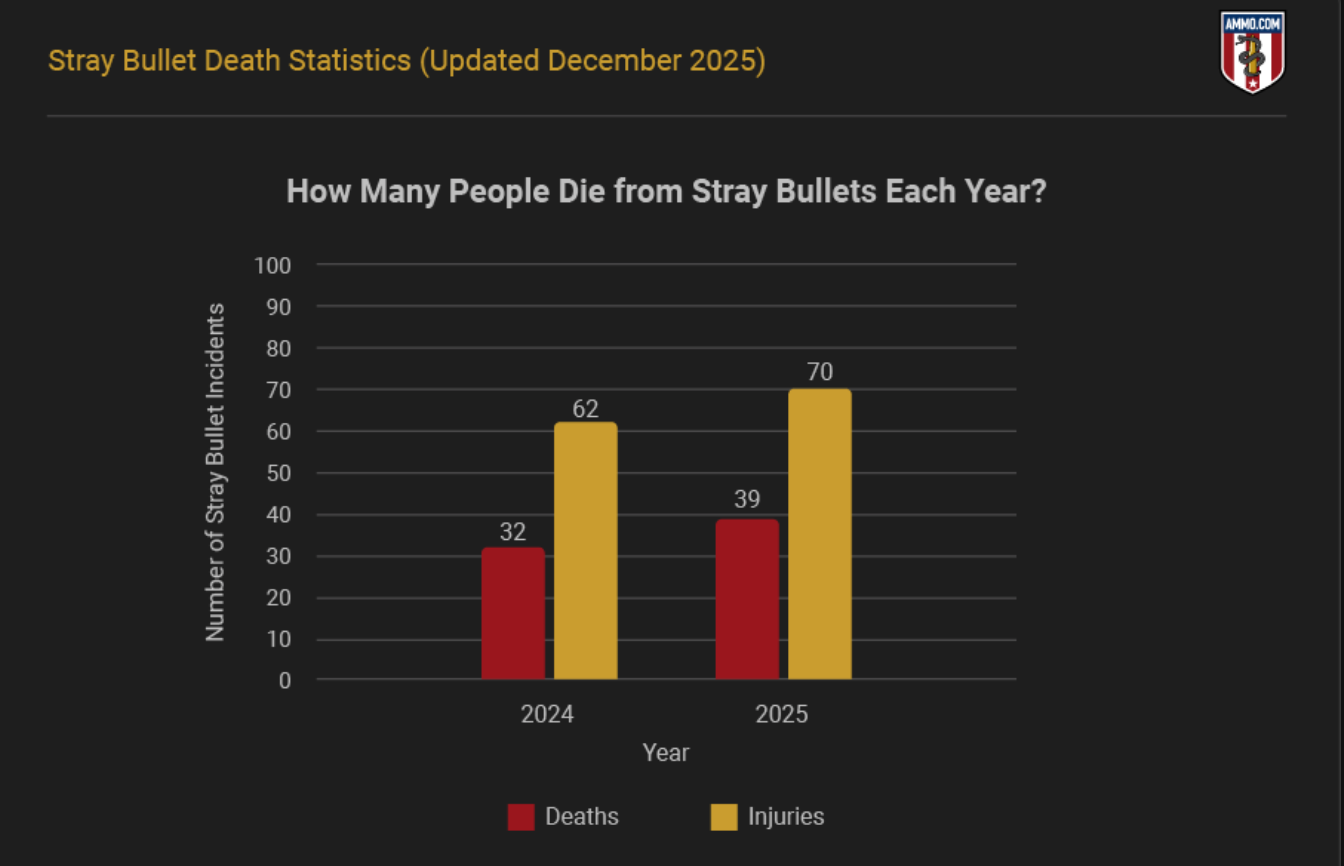
Seventy-one stray bullet deaths were verified in the United States between January, 2024 and December, 2025. In 2024, 32 people were killed by stray bullets. That number rose to 39 the following year.
Compared to all other shooting injuries, stray bullet deaths appear to be the rarest. However, these types of shootings aren’t widely reported, and can be challenging to discern from other shooting incidents.
How Many People Die From Celebratory Gunfire Each Year?
Stray bullet deaths and injuries occur on New Year’s Eve and Independence Day at higher rates than on any other day. There were 16 confirmed incidents of celebratory gunfire deaths and injuries in 2024, and four in 2025.
Although exact counts are unavailable at the national and global levels, some studies offer greater insight into celebratory gunfire incidents. Celebratory gunfire often involves falling bullets (from gunshots aimed upwards). These bullets may return to earth at high velocity. For example, a .30 caliber bullet may fall faster than 300 fps (more than the 200 fps threshold to break skin).
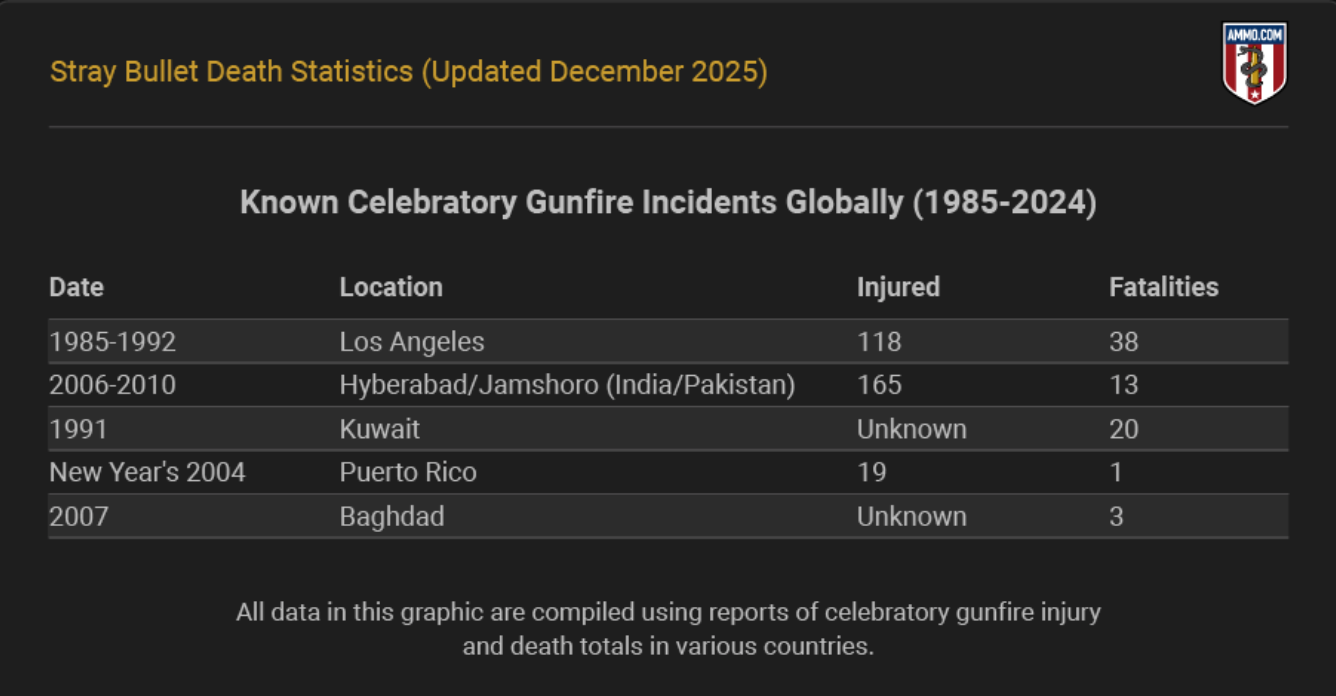
Celebratory gunfire injuries are most often inflicted on the head and feet, and can be lethal. Between 1985 and 1992, 118 patients in California were identified as wounded by falling bullets (celebratory gunfire). Of those, 32% died. 8 One hundred sixty-five injuries from celebratory gunfire were identified in India and Pakistan between 2006 and 2010. Of those, 13 died. 9
Number of Stray Bullet Incidents Each Year
Law enforcement agencies in some jurisdictions have implemented programs that detect and report gunshots. Chicago’s ShotSpotter system (discontinued in September, 2024) logged thousands of gunshots each year. 11 St. Louis received over 2,000 911 calls for celebratory gunfire on New Year’s in 2024. 10
Such systems don’t differentiate between stray bullets and those that hit their target. Still, with thousands of shots fired in these cities, it’s safe to assume there are many more nationwide.
There are hundreds of news stories about stray bullet incidents each year. Unfortunately, these don’t accurately represent all stray bullet incidents, as many may be misidentified or deemed not newsworthy. Furthermore, stray bullet incidents don’t always result in injuries. But they often involve damage to property and cause concern in affected communities.
Urban vs. Rural Stray Bullet Incidents Each Year
Rural areas do not have the same number of stray bullet incidents as urban ones. However, due to reporting issues, we can’t compare the number of stray bullet incidents, injuries, or deaths per capita.
Although we don’t have exact data relating to rural and urban stray bullet deaths, the CDC WONDER database does report all firearm-related deaths. Between 2018 and 2022, 64% of all firearm-related homicides, unintentional shootings, and unidentified deaths occurred in urban areas (250,000+ people).
Seventeen percent of deaths occurred in large suburban areas (1 million+ people); 19% occurred in small cities and rural areas. If we consider that more than 274 million Americans live in urban areas, and only 66 million live in rural ones, we can conclude that more bullets are flying per person in urban areas than rural ones (29/100k vs. 18/100k, respectively). 13
Most Common Caliber/Weapon Used
In the United States, the 9mm handgun is likely the most common firearm used in stray bullet incidents.
Although no database collects stray bullet information, the vast majority of stray bullets are linked to crime (per news reports). The ATF publishes crime gun reports each year, and 9mm handguns are consistently the firearms used in most criminal activities. 12
How Far Can a Stray Bullet Travel?
According to experiments in the 1940s, a .30 caliber bullet fired in the air will reach 9,000 feet before falling back to the earth at 300 fps. 5 A .22 LR bullet can travel farther than a mile, whereas a 9mm bullet can travel nearly three miles. 6
A bullet’s trajectory and the distance it can travel vary depending on its weight, shape, and caliber, as well as environmental conditions and several other factors. Even the smallest and least powerful cartridges can harm people and damage property several hundred yards away.
Countries With the Highest and Lowest Rates of Stray Bullet Deaths
Stray bullet deaths aren’t a uniquely American issue. In fact, stray bullet deaths occur at much higher rates in Brazil, Mexico, Lebanon, and Iraq, per reports.
After local police cracked down on gangs, thousands of stray bullets led to school closings in Brazil. 14 Celebratory gunfire leads to many injuries and deaths in Iraq and Lebanon. 15, 16 Mexico’s drug wars often lead to stray bullet deaths and injuries. 17
The United Nations has done extensive research on stray bullet deaths in South America, as the issue tends to be more prevalent there than in other regions. 18 Brazil leads South America in the number of stray bullet deaths, with 98 of the 371 regional reports occurring in that country. 19
What Are the Chances of Getting Hit by a Stray Bullet?
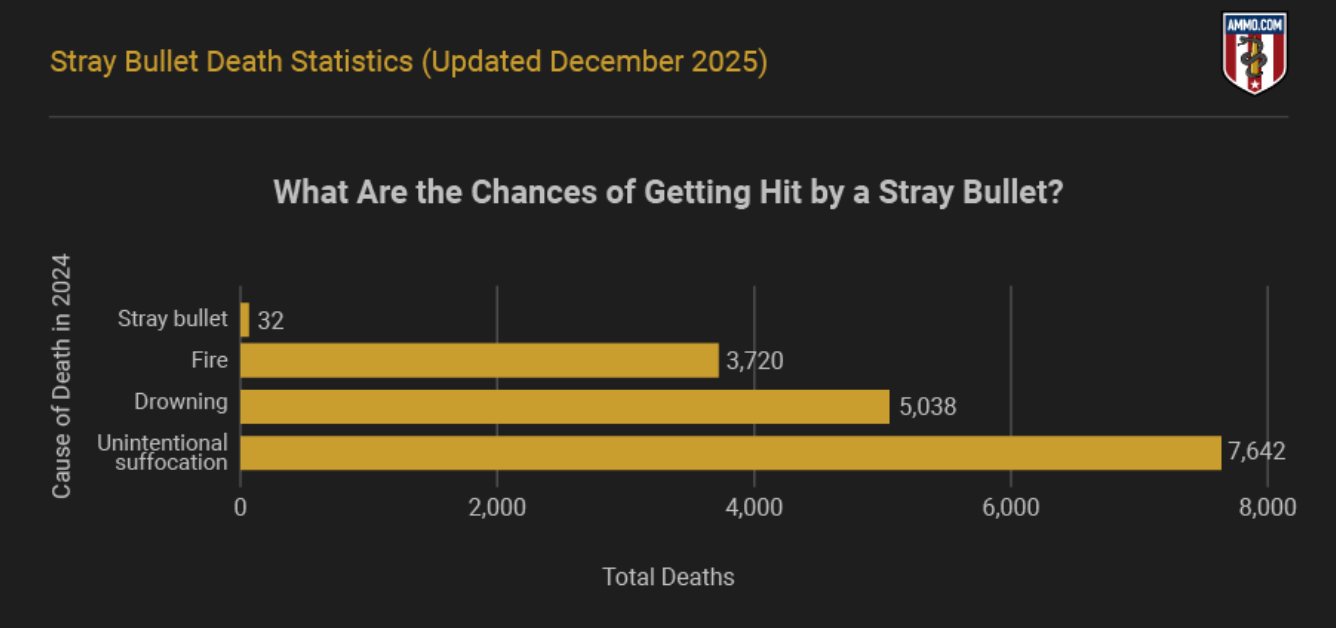
Based on national fatality data, Americans are approximately 116 times more likely to die in a fire (3,720 deaths in 2024), 157 times more likely to drown (5,038 deaths), and 239 times more likely to die from unintentional suffocation (7,642 deaths) than from a stray bullet (32 deaths). 13
Although stray bullet incidents are likely underrepresented and often misidentified, evidence supports the fact that deaths are rare compared to the number of bullets flying. Injuries related to stray bullets are much more common; property damage, even more so.
Stray Bullets: What Goes Up Must Come Down
Stray bullets end lives and terrorize communities all over the globe. Despite limited research, news articles provide valuable insight into the effects of stray bullets on individuals and communities.
Property damage and injuries resulting from careless discharge are more probable than deaths. However, the exact totals are unknown due to reporting issues and misidentification.
Sources:
- Deaths and Injuries due to All Injury among Persons Aged All Ages Years, 2018 to 2022, United States
- Epidemiology and clinical aspects of stray bullet shootings in the United States
- Stray Bullet Shootings in the United States
- Gun Violence Archive: Unintentional Injuries 2024
- Where Do Bullets Go
- Expert: The Average Person Doesn’t Know How Far a Bullet Travels
- Celebratory Gunfire Continued New Year’s Eve with Deadly Consequences
- Spent Bullets and Their Injuries
- The Incidents, Pattern, and Outcome of Stray Bullet Injuries
- How Many Calls Did Police Get for Celebratory Gunfire on New Year’s Eve?
- Violence Reduction – ShotSpotter – Historical
- Firearm Trace Data
- Provisional Mortality Statistics
- Stray bullets and closed schools: Rio’s kids suffer as police crack down on gangs
- Iraq counts cost of stray bullets fired in anger or joy
- Lebanon: reports of children seriously injured in so called-celebratory gunfire following elections results
- Boy, 12, killed by stray bullet from gunmen on jet skis as Mexico’s drugs war hits boiling point
- UNLIREC Launches study on stray bullets in Latin America and the Caribbean
- Brazil Tops Latin America Ranking of Stray Bullet Deaths, UN Says
- 2020 Census Urban Facts
LegalReader thanks our friends at Ammo.com for permission to republish this report. The original is found here.
Join the conversation!