
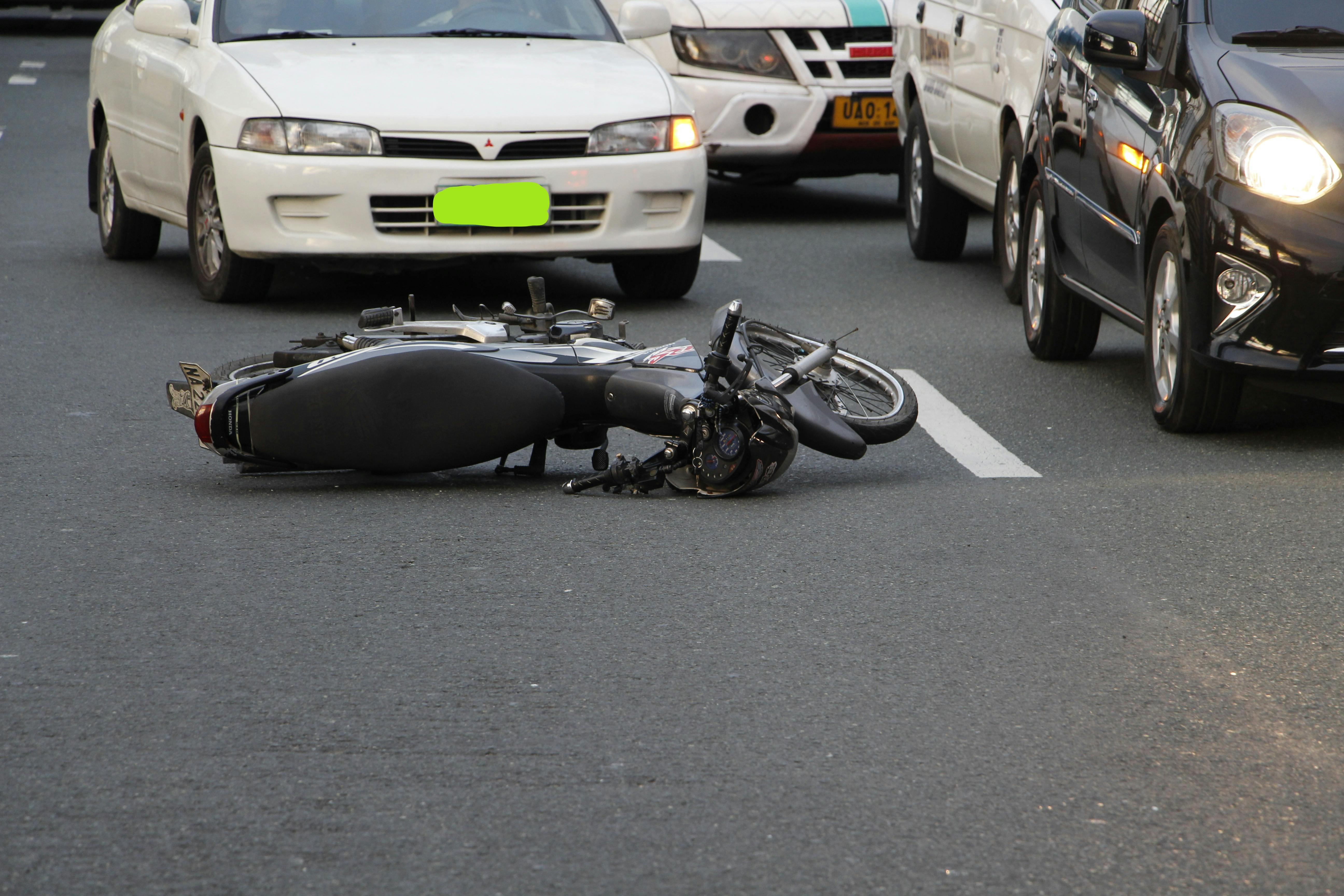
Most truck and motorcycle accidents are largely avoidable.
Consider this common scenario: you’re driving on the highway in the right or center lane, at or around the posted speed limit, in fairly heavy but moving traffic. You look in the rearview mirror, and see a truck fast approaching from behind, at a speed much faster than your own – and not just any truck, but a full size 18 wheel tractor trailer. With one vehicle ahead of you and another on your side, you’re trapped. The only thing left to do is hope that the seemingly certain impact won’t be too heavy.
Or consider another common scenario: you’re driving in a perfectly safe manner when you see a motorcycle (or maybe a few of them – they tend to ride in packs) whizz by you, darting in and out of traffic lanes, coming very close to hitting you.
According to The National Safety Council, in 2023, 5,375 large trucks were involved in a fatal crash, an 8.4% decrease from 2022 but a 43% increase in the last 10 years. For purposes of the above study, the NSC defined large trucks as any medium or heavy truck, not including buses and motor homes, with a gross vehicle weight rating greater than 10,000 pounds. Large trucks weigh more than most other vehicles, which would account for the extent of damage caused by such collisions.
But that only states the obvious, as it accounts only for large truck accidents, and is only one reason why truck accidents cause such damage. Consumer Reports, cited a study from the Governors Highway Safety Association that as of 2020, pedestrian fatalities rose 46 percent over the previous decade. CR suggests that the increasing dimensions of pickup trucks (not considered to be “large trucks” in the above NSC study) may be contributing to the deadliness of crashes, especially involving pedestrian or smaller vehicles. That article notes that safety equipment, such as automatic emergency braking (AEB) with pedestrian detection has been shown to prevent crashes. The feature has recently become standard on nearly all standard-duty pickup trucks, but as of August 2024 (the date of the updated article) remained unavailable on the Jeep Gladiator.
It should come as no surprise that driver error is 10 times more likely to be the cause of a truck accident crash than any other factor. The mistake of a driver driving a 10,000 pound 18 wheeler can be a lot more serious than when the involved vehicle is a sub-compact.
The New York No Fault Law recognizes this danger. New York Insurance Law Section 5105 permits an insurer which pays No Fault benefits to an insured in an accident with an at fault vehicle weighing in excess of 6,500 pounds unloaded to recover the amount paid in to that insured. That is a special provision of the No Fault, law, as the right of reimbursement is not ordinarily granted to No Fault insurers.
By their nature, motorcycles weigh much less than other vehicles, but riders tend to suffer more serious injury than other vehicle occupants. Motorcyclists lack the physical protection provided by cars and trucks, and are more vulnerable to injury. Even when riders wear helmets and protective gear, the human body simply cannot absorb the enormous force of a collision with a multi-ton vehicle. Nor, for that matter, can the human body readily absorb the force of contact with the ground or other object resulting from a motorcycle whizzing in and out of traffic at an excessive rate of speed.
That is no doubt the reason why New York exempts motorcycle occupants from the No Fault law. Pursuant to New York Insurance Law §5103, motorcycle occupants are not entitled to “first party benefits” (the technical term for No Fault benefits) – meaning the ability to receive insurance coverage for medical expenses arising from an accident is dependent upon whether a motorcycle occupant maintains health insurance.
But the news is not all negative for motorcycle operators and passengers. Since motorcycle occupants are not eligible for No Fault benefits, (a “motorcycle” is not a “motor vehicle”, and an occupant is therefore not a “covered person” eligible for No Fault benefits – see, New York Insurance Law §5102), occupants of a motorcycle need prove that they sustained a “Serious Injury” in order to sue a negligent vehicle operator for non-economic loss (generally known as pain and suffering) (see, Insurance Law §§5102, 5104). Due to the limitations imposed by the statutory definition of “Serious Injury”, injuries which one might consider to be serious – for example, a rotator cuff tear repaired by arthroscopic surgery – do not automatically meet the “Serious Injury” definition. Motorcycle operators do not have to be concerned with this branch of New York automobile accident law.
Finally, New York is a “pure comparative negligence” state, meaning that an injured party’s own comparative fault is considered when damages are assessed. However, unlike in “modified comparative negligence” states, a New York accident victim can recover even if his or her own negligence exceeds fifty percent. Modified comparative negligence states will bar recovery if the victim’s negligence percentage exceeds fifty or fifty one percent. New York’s prior “contributory negligence’ rule, in which a party’s recovery was barred if he or she was even one percent at fault, has long since been rescinded.
Most truck and motorcycle accidents are largely avoidable. Safe and responsible vehicle operation at reasonable speeds under the prevailing circumstances can go a long way to avoiding an engagement in the above tutorial on New York motor vehicle accident recovery.
Join the conversation!