
Military command responsibility reflects a fundamental principle: accountability cannot be compartmentalized.
Military command responsibility is a well-established doctrine of criminal law that allows commanders and other superiors to be held liable for crimes committed by subordinates under their authority.
Liability does not depend on proof that the commander personally committed, ordered, or participated in the unlawful conduct. Instead, responsibility may arise when a superior knew, or should have known, that violations were occurring and failed to take reasonable steps to prevent or address them.
For attorneys handling military, human rights, or international criminal matters, understanding the doctrine requires more than familiarity with its basic principles. Effective analysis often depends on evaluating command relationships, operational realities, available information, and the actions taken by those in positions of authority.
The Origins of Military Command Responsibility
The modern doctrine of military command responsibility traces its roots to the aftermath of World War II. One of the most influential cases involved Japanese General Tomoyuki Yamashita, who was prosecuted by a United States military tribunal for atrocities committed by forces under his command in the Philippines.
Although prosecutors did not establish that Yamashita personally ordered the violations, the tribunal concluded that commanders have an affirmative obligation to maintain control over their forces and respond to unlawful conduct. The case established the principle that authority carries responsibility and that commanders may be held accountable for failing to exercise that authority appropriately.
The doctrine was later incorporated into international humanitarian law, including Article 86 of the 1977 Additional Protocol I to the Geneva Conventions. Today, command responsibility remains a foundational concept in international criminal prosecutions involving war crimes, crimes against humanity, and other serious violations of international law.
The Three Elements of Military Command Responsibility
To establish military command responsibility, prosecutors generally must prove these three elements.
1. Superior-Subordinate Relationship
The first requirement is a relationship between the accused and the individual who committed the underlying offense.
The critical inquiry is not rank alone. Courts assess whether the superior exercised effective control over the subordinate. Effective control refers to the material ability to prevent or punish criminal conduct. This standard applies equally to formal military structures, militia leaders, paramilitary officials, and civilian authorities exercising de facto authority over armed forces.
2. Knowledge of the Misconduct
The second element concerns what the superior knew, or reasonably should have known, about the unlawful conduct.
Different tribunals have applied different standards.
- Knew or should have known: Under Rome Statute Article 28, military commanders may be held liable when they knew or should have known that crimes were being committed. This standard imposes a duty to remain informed about the actions of subordinate forces.
- Had reason to know: International Criminal Tribunal for the former Yugoslavia (ICTY) and International Criminal Tribunal for Rwanda (ICTR) decisions frequently applied a “had reason to know” standard. Under that approach, prosecutors generally must demonstrate that information existed which would have alerted the commander to potential misconduct.
Although the standards differ in wording, both focus on whether warning signs existed and whether the commander responded appropriately to available information.
3. Failure to Prevent or Punish
The final element is a failure to take reasonable action.
A commander who becomes aware of potential violations has two distinct obligations. First, the commander must take reasonable measures to prevent future misconduct. Second, if violations have already occurred, the commander must take appropriate steps to investigate, discipline, or otherwise address the conduct.
Liability may arise when a superior fails to fulfill either obligation. Courts have consistently distinguished meaningful corrective action from measures that are merely symbolic or designed to create the appearance of accountability.
Military vs. Civilian Commanders Under Rome Statute Article 28
Rome Statute Article 28 draws a meaningful distinction between military and civilian superiors:
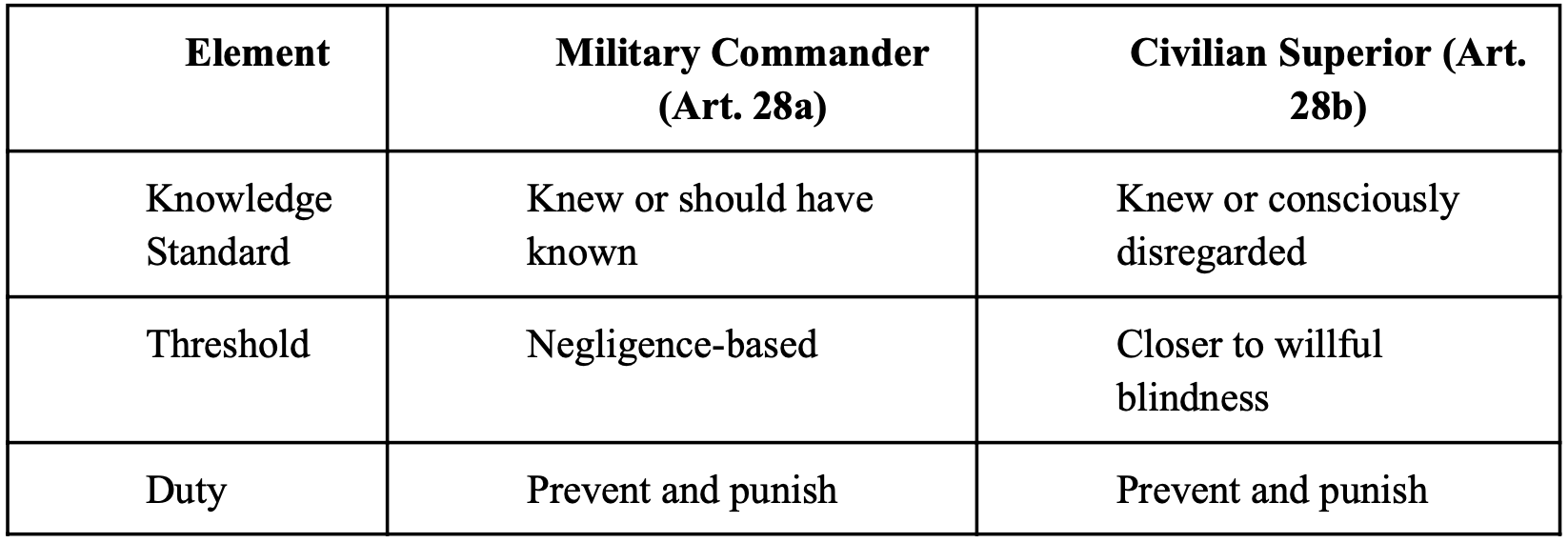
For military commanders, liability may arise when they knew or should have known of the misconduct.
For civilian superiors, prosecutors must establish that the individual either knew of the conduct or consciously disregarded information indicating that violations were occurring.
Civilian superiors face a higher evidentiary threshold. The “consciously disregarded” language requires something closer to willful blindness, making these cases generally harder to establish than those against military commanders.
Three Landmark Cases That Shaped the Doctrine
Prosecutor v. Delalic et al. (Celebici Case) — ICTY, 1998 The Appeals Chamber clarified that “had reason to know” requires specific alerting information to have been available, not merely obtainable through inquiry. It affirmed that effective control military law requires is assessed by actual authority, not formal title.
Prosecutor v. Blaskic — ICTY, 2000 and 2004 The Appeals Chamber substantially reduced Blaskic’s conviction, applying a narrower reading of the knowledge element. The case is a critical reminder that this element must be established through specific evidence and is never presumed.
Prosecutor v. Bemba — ICC, 2016 and 2018 The ICC’s most significant military command responsibility prosecution ended in acquittal on appeal. The Appeals Chamber found that geographic distance and operational constraints are relevant factors in assessing the commander’s duty, a finding with lasting implications for how superior responsibility cases are argued today.
How Do Attorneys Build and Defend Command Responsibility Cases?
Command responsibility cases are often document-intensive and fact-driven.
1. Building the evidentiary record. Military command responsibility cases are built on documentation. Prosecutors commonly rely on operational orders, intelligence reports, communications, after-action reviews, disciplinary records, and witness testimony to establish the existence of effective control and knowledge.
2. Defending command responsibility charges. Common strategies include challenging effective control military law requires in irregular force structures, contesting the knowledge element by demonstrating that alerting information was unavailable, and establishing that the commander took all reasonable measures given their actual authority and constraints.
3. Working with experts. Because military organizations often operate within complex chains of command, expert testimony frequently plays a significant role in explaining command relationships, operational authority, military doctrine, and decision-making processes.
What Are the Jurisdictional Paths for Command Responsibility Claims?
Military command responsibility claims may arise in several legal forums.
At the international level, prosecutions are commonly associated with the International Criminal Court and ad hoc international tribunals. The ICC’s complementarity framework requires courts to consider whether a state is already conducting a genuine investigation or prosecution before exercising jurisdiction.
Within the United States, military misconduct may be addressed through proceedings under the Uniform Code of Military Justice. Certain allegations may also implicate the War Crimes Act and related federal statutes.
Civil litigation presents additional jurisdictional challenges. The Alien Tort Statute used to offer a broader path for command responsibility litigation in U.S. courts, but Kiobel (2013) and Nestle (2021) pulled that back considerably.
For attorneys, jurisdictional analysis should be addressed early in the litigation process, as it often determines the available causes of action, defenses, and procedural pathways.
Conclusion
Military command responsibility reflects a fundamental principle: accountability cannot be compartmentalized. Commanders and other superiors may face liability not only for actions they direct but also for failures to prevent, investigate, or address unlawful conduct committed by those under their authority.
Although the doctrine appears straightforward in theory, its application often requires careful examination of command structures, operational realities, available information, and the reasonableness of a superior’s response. For attorneys litigating these matters, understanding those factual and legal distinctions is essential to evaluating both liability and defense.
Frequently Asked Questions
What is military command responsibility?
Military command responsibility holds commanders criminally accountable for their subordinates’ actions, but only when two conditions are met: the commander knew, or should have known, that crimes were taking place, and they failed to either stop them or hold the responsible parties accountable afterward.
What is the difference between the ICC and ICTY knowledge standards?
Under Rome Statute Article 28, the ICC applies a “knew or should have known” standard, creating a broad duty of inquiry. The ICTY applied a “had reason to know” standard requiring that specific alerting information was actually available. The ICC standard is broader and more demanding on prosecutors.
Can civilian leaders be held liable under the command responsibility doctrine?
Yes, but the standard is tougher to meet. Article 28(b) reaches civilian superiors, though negligence alone won’t get a prosecutor there. They need to show the official actually knew, or made a point of not finding out. Courts treat that second scenario as close to willful blindness.
What does effective control mean in these cases?
It has little to do with rank on paper. The real question is whether the commander had genuine authority: could they give orders that were followed, and could they discipline someone who stepped out of line? Judges weigh this case by case, looking at how command actually worked in practice rather than how it was written down.
Is military command responsibility recognized in U.S. law?
Yes. Both the Uniform Code of Military Justice and the War Crimes Act, 18 U.S.C. § 2441, are built on this principle. A commander can face court-martial for dereliction of duty, and the War Crimes Act addresses grave breaches of the Geneva Conventions. Civil claims under the Alien Tort Statute are sometimes available too, though only in limited circumstances.
Sources:
- ICRC. Additional Protocol I, Article 86 (1977). https://ihl-databases.icrc.org/en/ihl-treaties/api-1977/article-86/commentary/1987
- ICC. Rome Statute, Article 28 (1998). https://www.icc-cpi.int/sites/default/files/Rome-Statute.pdf
- ICC. Prosecutor v. Bemba (2016, 2018). https://www.icc-cpi.int/car/bemba
- ICTY . Prosecutor v. Delalic et al. (1998). https://www.icty.org/en/case/mucic
- ICTY . Prosecutor v. Blaskic (2000, 2004). https://www.icty.org/en/case/blaskic
- Library of Congress. Uniform Code of Military Justice. https://www.loc.gov/collections/military-legal-resources/articles-and-essays/military-law-and-legislative-histories/uniform-code-of-military-justice-1946-to-1951/
- U.S. House of Representatives. War Crimes Act, 18 U.S.C. § 2441. https://uscode.house.gov/view.xhtml?req=granuleid:USC-prelim-title18-section2441&num=0&edition=prelim
- U.S. Supreme Court. In re Yamashita, 327 U.S. 1 (1946).
- U.S. Supreme Court. Kiobel v. Royal Dutch Petroleum Co., 569 U.S. 108 (2013).
- U.S. Supreme Court. Nestle USA, Inc. v. Doe, 593 U.S. 628 (2021).
Join the conversation!