

While the road to physical and financial recovery can be long, understanding the framework of liability provides the clarity needed to navigate the journey and protect your rights with confidence.
Driving alongside a massive 18-wheeler on I-26 or I-95 can be an intimidating experience. You understand the sheer size difference and the potential for devastation. For thousands of South Carolina residents, this scenario becomes a life-altering reality each year. According to state data, in 2023, South Carolina saw 6,442 collisions involving truck tractors, leading to 81 fatalities and over a thousand injuries. For victims and their families, the path to recovery is often complicated by a legal battle far more complex than a typical car crash claim. Determining fault isn’t just about one driver’s mistake; it involves a tangled web of state laws, federal regulations, and multiple corporate entities. This guide will unravel that complexity, providing you with the clarity needed to understand your rights.
Successfully navigating these intricate cases requires a deep understanding of both state and federal law, which is why victims often find it necessary to partner with a skilled South Carolina semitruck accident lawyer. Such a professional is equipped to handle the aggressive tactics of commercial insurance companies and unearth the evidence needed to hold all responsible parties accountable. They work to ensure your focus remains on healing while they manage the demanding legal process, from investigation to settlement negotiation or trial.
Why Big Rig Collisions Are a Different Beast
A collision with a commercial truck is fundamentally different from one with another passenger car. The disparities in size, regulation, and the number of potentially at-fault parties create a unique and challenging legal environment. Understanding these differences is the first step toward protecting your rights and pursuing the compensation you deserve for your injuries and losses. The stakes are considerably higher due to the catastrophic potential of these accidents and the complex corporate structures designed to limit liability.
The Overwhelming Scale of Damage and Injury
The basic physics of a truck accident explain why the outcomes are so often devastating. A fully loaded tractor-trailer can tip the scales at roughly 80,000 pounds, compared with about 4,000 pounds for a typical passenger vehicle. When these two forces collide, the occupants of the smaller vehicle almost always bear the brunt of the impact. National statistics starkly illustrate this danger. According to the National Highway Traffic Safety Administration (NHTSA), 70% of those killed and 70% of those injured in large-truck crashes in 2023 were occupants of other vehicles. This overwhelming disparity underscores why the investigation and liability determination process is so critical.
The Web of Federal and State Regulations
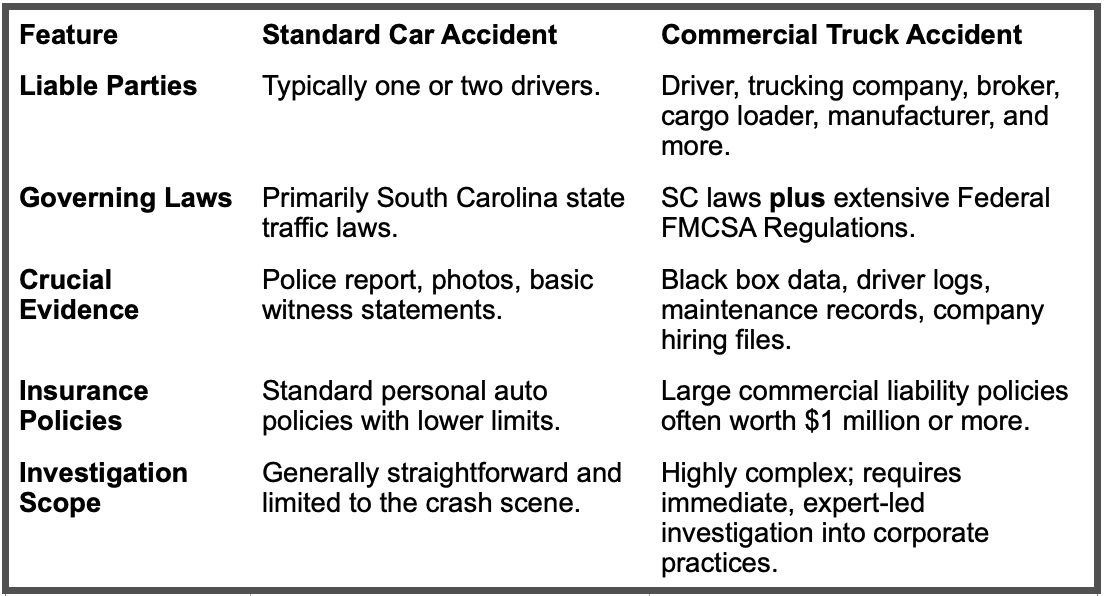
While a standard car accident is governed almost exclusively by South Carolina state traffic laws, a commercial truck accident falls under a dual system of state and federal oversight. The primary regulatory body is the Federal Motor Carrier Safety Administration (FMCSA), an agency within the U.S. Department of Transportation. The FMCSA is dedicated to lowering the number of crashes, injuries, and deaths involving large trucks and buses. Its extensive rules, known as the Federal Motor Carrier Safety Regulations (FMCSRs), cover everything from how long a driver can be on the road without a break to vehicle maintenance standards and driver qualification requirements. A violation of these federal rules can be powerful evidence of negligence in an accident claim.
At a Glance: Car Crash vs. Truck Accident Claims
To summarize the crucial distinctions, consider the differences in how these two types of claims are handled from investigation to resolution.
Unpacking Negligence: Common Causes and Key Evidence in SC
Proving liability in a truck accident case requires demonstrating that one or more parties acted negligently, and this negligence directly caused your injuries. While the driver’s actions at the moment of the crash are important, the investigation often reveals systemic failures that created the conditions for the disaster to happen. From corporate pressure to meet unrealistic deadlines to neglected vehicle maintenance, the root causes are frequently found far from the crash scene itself.
The Driver’s Role: Beyond a Simple Mistake
While a truck driver’s error might be the immediate trigger for a collision, it is often a symptom of a larger problem. Proving driver negligence involves identifying a specific violation of the standard of care expected of a professional commercial driver. Common examples of driver negligence include:
- Driver Fatigue: The FMCSA’s Hours of Service regulations strictly limit the number of consecutive hours a trucker can drive and mandate rest periods. However, intense pressure from trucking companies can lead drivers to violate these rules, making drowsy driving a major hazard on South Carolina’s roads.
- Distracted Driving: The FMCSA has strict rules against texting or using handheld cell phones while operating a commercial vehicle. This has become a point of emphasis in South Carolina, which recently implemented penalties for holding a phone while driving. As reported by WISTV, starting in 2026, there will be no more warnings, with fines and points assessed for violations.
- Impaired Driving (DUI): The standard of care for commercial drivers is much higher regarding alcohol. The blood alcohol content (BAC) limit for a commercial driver is .04%, which is half the .08% limit for operators of passenger vehicles.
- Speeding and Aggressive Driving: The pressure to make deliveries on time can lead to speeding and other aggressive behaviors. This is particularly dangerous in known hotspots for truck traffic and accidents in South Carolina, such as the I-95 corridor, I-26 between Columbia and Charleston, and I-85 near Greenville.
The Black Box and the Paper Trail: Crucial Evidence to Secure
Unlike in most car accidents, the evidence needed to prove fault in a truck accident case is often in the possession of the trucking company. This data is essential for understanding what truly happened, but it can be lost or destroyed if a formal request, known as a spoliation letter, is not sent immediately by an attorney. This evidence provides an objective look into the driver’s actions and the company’s operational practices.
- Electronic Logging Device (ELD) or Black Box Data: This device records critical information from moments before, during, and after a crash, including the truck’s speed, braking activity, RPMs, and hours of service compliance.
- Driver’s Qualification File: Trucking companies are required to maintain a detailed file on every driver, which includes their employment history, training records, driving record, and drug and alcohol test results.
- Truck Inspection and Maintenance Records: These documents can reveal a history of mechanical problems, shoddy repairs, or neglected safety checks that may have contributed to the accident.
- Post-Collision Drug and Alcohol Test Results: FMCSA regulations mandate that drivers undergo drug and alcohol testing after any crash involving a fatality or, in many cases, serious injuries.
- Cargo Loading and Weight Manifests: This paperwork can show if the truck was overloaded or if its cargo was improperly balanced, which can cause a driver to lose control and lead to a jackknife or rollover accident.
- Company Dispatch Logs and Communication Records: Communications between the driver and the dispatcher can reveal if the driver was being pressured to violate safety regulations or meet an unrealistic delivery schedule.
The Chain of Liability: Who is Legally Responsible?
One of the most significant differences in a commercial truck accident claim is the number of potentially liable parties. The responsibility rarely stops with the driver. An experienced legal team will investigate every link in the chain of commerce to identify all individuals and corporate entities whose negligence contributed to the crash. This broad approach is essential to ensuring victims can access the full compensation needed to cover catastrophic injuries and long-term care.
The Driver and Vicarious Liability
In nearly all cases involving an employee driver, the trucking company can be held responsible for the driver’s negligence under a legal doctrine known as vicarious liability. In simple terms, this principle holds an employer legally responsible for the wrongful acts of an employee, as long as the employee was acting within the scope of their employment at the time of the incident. Because the truck driver was on the job, the trucking company is almost always a primary defendant in a crash claim, providing a path to their substantial commercial insurance policy.
When the Trucking Company is Directly at Fault
Beyond vicarious liability, a trucking company can also be held directly negligent for its own failures. This occurs when the company’s own careless actions or policies contribute to the accident. Examples of direct negligence include negligent hiring (such as hiring a driver with a known history of DUIs or reckless driving), providing inadequate training on safety procedures, failing to perform required vehicle maintenance and inspections, or creating compensation systems that implicitly encourage drivers to speed or violate hours-of-service rules to earn more money.
Expanding the Search for Responsible Parties
The investigation may also uncover negligence on the part of other entities. This can include freight brokers who knowingly set unrealistic and dangerous delivery schedules, separate cargo loading companies that fail to properly secure freight, or truck and parts manufacturers who produce defective equipment, like faulty brakes or tires that fail under pressure. Identifying these multiple layers of fault is where the complexity of a truck accident claim truly lies. It requires a deep dive into corporate structures, maintenance logs, and federal compliance records—a task that can overwhelm victims struggling with recovery. This is why specialized legal expertise is crucial. Firms like Jeffcoat Injury and Car Accident Lawyers focus on these intricate investigations. Their approach involves deploying accident reconstruction experts and meticulously analyzing every piece of evidence to build a comprehensive case against all responsible parties. This ensures that no stone is left unturned in the pursuit of fair compensation for their clients.
Your Roadmap to a Just Recovery
The aftermath of a serious truck accident is chaotic and painful. However, understanding the legal framework that governs these complex cases can empower you to take the right steps to protect your future. Truck accidents are not just bigger car accidents; they are governed by a complex set of federal rules, often involve multiple liable corporate parties, and require a swift, expert-led investigation to preserve critical evidence. By knowing what to expect, you can better advocate for your rights and focus on what matters most: your physical and emotional recovery.
While the road to physical and financial recovery can be long, understanding the framework of liability provides the clarity needed to navigate the journey and protect your rights with confidence. Facing off against a major trucking company and its insurance carrier is not a battle you should fight alone. Armed with the right information and the right legal support, you can hold negligent parties accountable and secure the resources necessary to rebuild your life.
The information provided in this article does not, and is not intended to, constitute legal advice; instead, all information, content, and materials available on this site are for general informational purposes only.
Join the conversation!