
When filing evidence with a court, certified human translations still control.
Welcome to the new multilingual reality of global disputes. International lawsuits no longer involve just multiple jurisdictions; they involve multiple languages, multiple versions of the same document, and multiple interpretations of key communications. As companies expand supply chains, outsource operations, and sell globally, courts are confronting a surge in multilingual evidence:
- cross-border emails
- bilingual contracts
- multilingual warning labels
- international HR and compliance records
- foreign-language consumer complaints
- multilingual product manuals
In complex cases, what a party understood, and in which language, can swing liability dramatically. This has transformed multilingual evidence from a niche issue into a core driver of modern litigation outcomes. Legal authorities such as Crowell & Moring’s Cross-Border Litigation Guide has noted that multilingual evidence is increasingly decisive in global disputes.
Because case timelines move faster than translated documents can be certified, legal teams increasingly rely on MachineTranslation.com, a high-accuracy and free AI translation tool that supports over a million users, processes billions of translated words, and provides legal-friendly features needed to manage multilingual evidence without compromising defensibility.
1. How Courts Evaluate Multilingual Evidence Today
1.1. Courts Now Scrutinize “What Was Understood When”
Judges focus on whether a party reasonably understood:
- the contractual obligation
- the warning label
- the risk disclosure
- the regulatory requirement
The question is no longer “What does this document say?”
It is now:
“In which language did the parties act, rely, or misinterpret the meaning?”
Liability frequently shifts when:
- language versions conflict
- translations were inaccurate
- one party spoke both languages and leveraged ambiguity
- a party failed to verify a machine translation before acting on it
1.2. Machine Translations Are Admissible — With Limits
Most jurisdictions allow machine-translated documents for:
- discovery
- early case assessment
- privilege review
- internal investigations
- multilingual e-discovery sorting
- red-flag identification
But when filing evidence with a court, certified human translations still control. Courts also caution parties that reliance on faulty MT can increase liability. This proves a statement in a blog on Legal Translation, it will still need to be reviewed, shared, and adopted across jurisdictions. That means translating large volumes of legal text into dozens of languages quickly, but without compromising quality
2. The Five Litigation Areas Where Multilingual Evidence Changes Outcomes
2.1 Contract Disputes
Bilingual contracts often include a “controlling language clause.”
If the versions diverge, courts evaluate:
- reliance during negotiation
- whether mistranslation created unfairness
- whether ambiguity was exploited
2.2 Product Liability
Manufacturers face heightened exposure when:
- safety instructions differ across languages
- manuals contradict one another
- incorrect translations mislead installers
Regulators increasingly consider mistranslation a failure to warn.
2.3 Employment & Workplace Claims
Inconsistent multilingual HR documents impact:
- consent
- discipline
- worker safety
- termination fairness
Courts ask whether employees were given clear, equivalent information.
2.4 Data Privacy & Regulated Industries
Incorrectly translated privacy policies can lead to:
- GDPR penalties
- consumer lawsuits
- cross-border compliance failures
Even minor shifts like “may collect” → “will collect” can trigger exposure.
2.5 Cross-Border Fraud & Misrepresentation
Mistranslations can reveal:
- deceptive intent
- knowledge of falsity
- reckless reliance on automated tools
This area is expanding rapidly.
3. How MachineTranslation.com Supports Defensible Litigation Workflows
Legal teams trust MachineTranslation.com because it provides:
- accuracy
- auditability
- speed
- scale
3.1 Immediate Translation of Massive Document Sets
MachineTranslation.com processes large collections of:
- multilingual emails
- attachments
- WhatsApp messages
- supplier communication
This enables lawyers to quickly identify:
- custodians
- privilege
- key documents
- risk factors
3.2 Side-by-Side Translation View
Attorneys can simultaneously see:
- source text
- MT output
- glossary-applied terminology
3.3 Built-In Quality Signals
MachineTranslation.com allows exporting:
- confidence scores
- revision logs
- translation memory matches
- audit trails
These features strengthen defensibility when challenged.
3.4 Multilingual Version Comparison
The platform identifies:
- mismatched clauses
- altered definitions
- missing obligations
- ambiguous language
across versions.
3.5 Enterprise Integrations
MachineTranslation.com is used by:
- compliance organizations
- global HR teams
- in-house counsel
- external law firms
- investigations teams
Because it’s secure and designed for legal workflows.
4. Example: How a Simple Mistranslation Alters Liability
Original German Clause
“Der Lieferant muss sicherstellen, dass alle Teile frei von Materialfehlern sind.”
Correct Translation
“The supplier must ensure that all parts are free from material defects.”
Strict obligation → full liability.
Faulty Translation
“The supplier should try to make sure that all parts are free of defects.”
Best-effort → reduced responsibility.
Impact on Liability
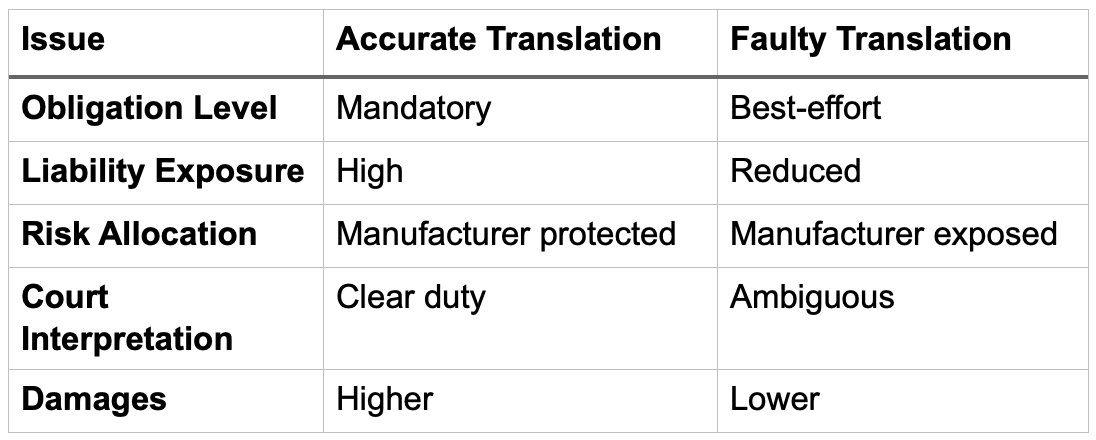
Such shifts can significantly alter:
- breach analysis
- indemnification triggers
- warranty enforcement
- damages calculations
- settlement leverage
5. Where MachineTranslation.com Prevents These Errors
5.1 Higher Accuracy Engines
The platform blends multiple AI models + legal-domain training.
5.2 Glossaries for Legal Terms
You can lock crucial definitions such as:
- indemnify
- strict liability
- must ensure
5.3 Alignment Tools
Side-by-side comparison reveals discrepancies immediately.
5.4 Exportable Audit Trails
MachineTranslation.com provides:
- timestamps
- glossaries used
- translation history
6. Best Practices for Attorneys Handling Multilingual Evidence
- Identify original source language
- Use MachineTranslation.com for early triage
- Escalate key passages to certified translators
- Compare MT, human, and original versions
- Preserve every language version
- Document all translation steps
Join the conversation!