
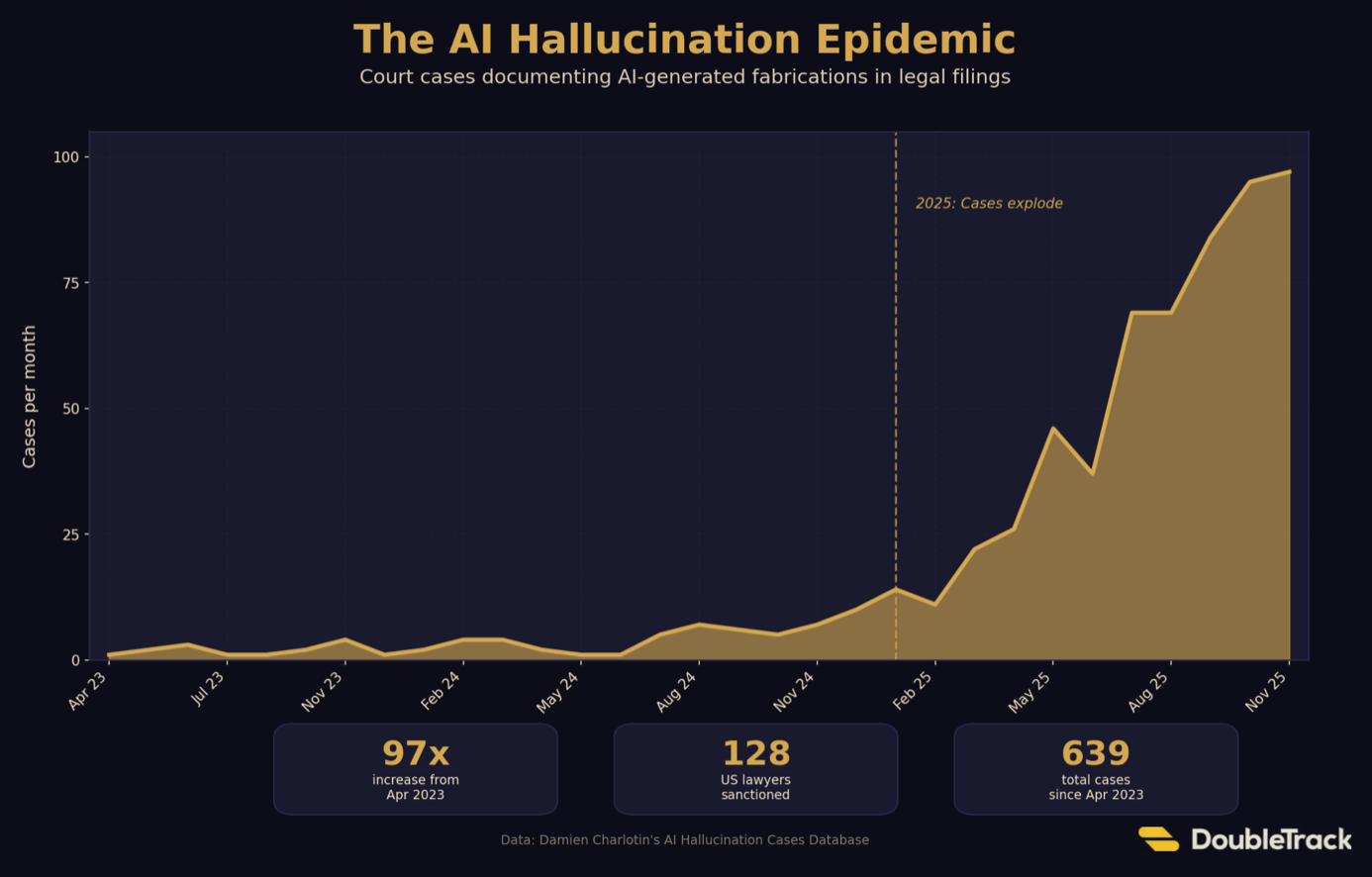
New research reveals legal sector hiring AI specialists at 181% higher rates than data engineers – while over 600 court cases have involved AI-generated hallucinations.
New research reveals the legal sector is hiring ‘AI specialists’ at 181% higher rates than data engineers – all while over 600 court cases have involved AI-generated hallucinations since 2023.
As a legal database now tracks over 670 cases involving AI-generated hallucinations in legal filings – with 128 lawyers sanctioned in the US alone – new research from data consultancy DoubleTrack reveals a troubling pattern: law firms are hiring AI specialists at nearly three times the rate of data infrastructure professionals, the very roles that could prevent these disasters.
The analysis of 187,567 US job postings found that law firms and legal departments are hiring AI specialists at 181% higher rates than database engineers, data platform engineers, and data quality analysts – the second-highest imbalance of any sector studied, behind only sales.
This comes as AI project failure rates have reached crisis levels. According to RAND Corporation, over 80% of AI projects fail, twice the failure rate of non-AI technology projects. MIT analysis of 300 corporate AI deployments found that 95% of generative AI pilots deliver zero measurable profit impact.
The Hallucination Epidemic
The consequences of deploying AI without proper data infrastructure are playing out in courtrooms. Damien Charlotin’s AI Hallucination Cases database tracks cases globally involving AI-generated fabrications in legal filings – including fake case citations, invented legal arguments, and non-existent precedents.
Key findings from the database and related research:
- 324 cases in US federal, state, and tribal courts
- 128 lawyers sanctioned in the US for AI-generated hallucinations
- Cases are now “popping up every day” according to database maintainer Charlotin
- Even purpose-built legal AI tools hallucinate 17-34% of the time (Stanford HAI)
The Root Cause: Building AI Without Foundations
“Law firms are essentially hiring race car drivers without hiring mechanics,” said Andy Boettcher, CIO at DoubleTrack. “They’re investing in AI talent that can’t deliver because the underlying data infrastructure doesn’t exist. The AI specialists end up spending months cleaning data, work that should have been handled by a properly staffed data team.”
The research found stark contrasts between sectors. While legal shows a 181% AI-over-data hiring imbalance, heavily regulated industries with high failure costs have inverted the ratio:
- Finance: 240% more data infrastructure hiring than AI
- Healthcare: 164% more data infrastructure hiring than AI
- Manufacturing: 273% more data infrastructure hiring than AI
“Finance, healthcare, and manufacturing aren’t anti-AI – they understand that AI implementations built on shaky data foundations will fail, and failure in their industries is expensive, regulated, or both. The legal sector should know better.”
A Regulated Sector Acting Like It Isn’t
The legal profession’s hiring pattern is particularly striking given its regulatory obligations. Lawyers face bar association oversight, ethics rules requiring competence with technology, and malpractice liability for errors. Yet the sector’s AI hiring behaviour mirrors that of unregulated industries chasing hype.
“The difference is that the legal sector’s regulation focuses on practitioner conduct, not data governance,” explains Boettcher. “There’s no equivalent of a HIPAA audit or SOX compliance review that would catch bad data practices before they cause problems. The failure only surfaces when a judge finds fabricated citations in a filing.”
Methodology
DoubleTrack analyzed 187,567 job postings collected via the Adzuna API in November 2025.
Forty roles were categorised as AI/ML (including machine learning engineers, AI scientists, and prompt engineers) or Data Infrastructure (including database engineers, data platform engineers, and data quality specialists).
Salary figures represent averages from postings that included compensation data. States with fewer than 100 total postings were excluded from the table.

What is DoubleTrack?
DoubleTrack was founded in 2018 because we want clients to realize value on their investments the first time, every time, without parsing through consultant-speak or frustrating experiences.
Join the conversation!