
AI improves this process by facilitating faster analysis and enhancing pattern recognition, which is important given the rise in extreme weather occurrences and associated conflicts.
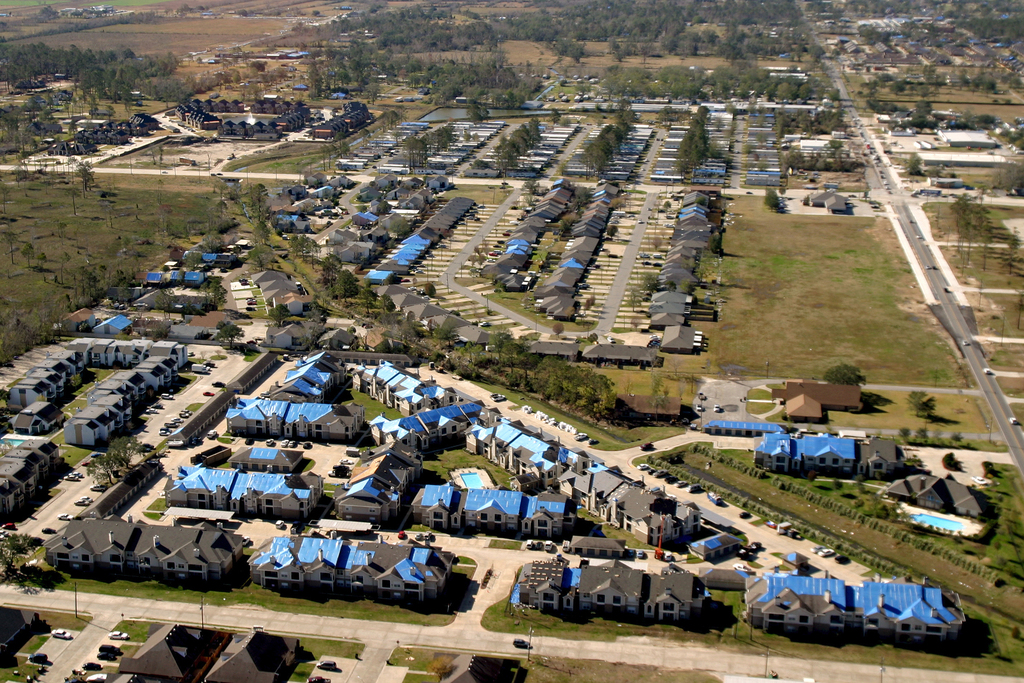
In May 2024, a powerful derecho (strong and long-lasting band of storms) swept through Houston, Texas. The storm brought sudden and violent wind bursts that tunneled through the city’s urban corridors, flattened structures, and knocked out power for hundreds of thousands of residents (NASA Earth Observatory, 2024).
When the damage was tallied, the numbers surprised even veteran insurance adjusters. The derecho caused more destruction to buildings than Hurricane Beryl, which struck the same city just two months later (Harvey, 2019). One storm was a slow-building, highly tracked tropical system. The others arrived in hours and left behind an insurance battleground because proving exactly what the wind did, when, and where, is a different science entirely from predicting that a storm was coming.
That is the science of forensic meteorology. And in an era when the United States is averaging more than 23 billion-dollar weather disasters per year (Igini, 2026) and nearly eight times the annual rate recorded at the turn of the century, its importance is growing faster than almost anyone outside the insurance and legal industries realizes.
The Difference Between Weather Forecasting and Weather Reconstruction
Forensic meteorology is frequently confused with weather forecasting. Yes, they share the same atmospheric science but serve opposite purposes.
A weather forecaster asks “What will happen?” while a forensic meteorologist asks “What did happen?”
The forecaster works with probability and future models. The forensic meteorologist works with historical data and a legal standard or what can be proven, documented, and defended under cross-examination.
What Forensic Meteorologists Do
To reconstruct past weather conditions, forensic meteorologists draw on a dense network of overlapping data sources.
The United States operated more than 900 Automated Surface Observing Systems (ASOS). These are weather stations run jointly by the National Weather Service, the Federal Aviation Administration, and the Department of Defense plus approximately 650 additional Automated Weather Observing System (AWOS) sites managed by state and local governments (NOAA, 2021). These stations record temperature, humidity, wind speed, precipitation, and other variables continuously.
But while stations may seem like enough to blanket the country, there can be sizable distances between them, and the weather at one station may not reflect what the weather was just a mile or two away.
That gap is where radar comes in. The United States maintains more than 200 combined Next Generation Weather Radar (NEXRAD) and Terminal Doppler Weather Radar (TDWR) systems, scanning the skies every one to two minutes (Mersereau, 2018). These systems allow forensic meteorologists to drill down to specific street corners and specific minutes and reconstruct whether it rained, how hard it is, what type of precipitation fell, and how wind speeds shifted over the course of an event.
Layered on top of radar and station data are satellite imagery, storm spotter reports compiled in NOAA’s Storm Events Database, upper-air balloon data, and atmospheric reanalysis. These retrospective models reconstruct past atmospheric states using observed measurements as inputs. A forensic meteorologist synthesizes all of these sources into a coherent picture of what the atmosphere was doing at one precise moment and place.
For example, when working with slip-and-fall cases, experts consider ground temperatures, sun exposure to a property, and freeze-and-thaw cycles. These local factors can produce ice on one side of a street and not the other, or create a hazardous patch in a shaded corner of a parking lot that a temperature reading from a nearby airport would never capture.
The cases that call for this kind of analysis cover a wide range. Slip-and-fall accidents on ice or wet surfaces. Motor vehicle collisions where fog, black ice, or road spray are in dispute. Aviation incidents involving turbulence, icing, or wind shear. Property insurance claims for hail, wind, or flood damage. Construction workplace accidents where the key question is whether dangerous wind conditions should have halted work. Environmental litigation examining how weather dispersed a pollutant. Wrongful death cases where the atmosphere is the only silent witness.
How AI is Changing the Work of Forensic Meteorologist
Artificial intelligence is now entering forensic meteorology as a set of tools that expand what a trained meteorologist can examine.
Faster archival analysis
Reconstructing a complex weather event has historically required manually cross-referencing radar sweeps, station logs, satellite passes, and model outputs. The process can stretch across days or weeks for events covering large areas. AI tools can generate historical weather reconstructions in minutes instead of weeks, on standard equipment without expensive supercomputer time, meaning weather evidence that once took weeks and cost thousands now takes minutes and runs on laptops (Withers, 2025). For insurance adjusters managing surge volumes after a major storm season, that compression of time has direct operational value.
Pattern recognition at local scales
AI systems trained on large atmospheric datasets can detect complex, non-linear patterns that are difficult to identify through manual analysis alone (Camps-Valls et al., 2025). In forensic applications, this means better tools for identifying microclimatic conditions. The specific combination of temperature trajectory, surface characteristics, sun angle, and humidity that would cause ice to form at one address but not another half a block away. AI spots weather patterns humans might miss, which is critical for identifying contributing factors in accidents when interpreted by experienced meteorologists.
Probabilistic evidence frameworks
Newer AI systems can generate ensemble outputs (combining multiple models) to produce a range of statistically weighted possibilities with associated confidence levels. This provides probability ranges instead of single predictions, which helps establish reasonable doubt or certainty when properly explained to juries. For legal arguments about foreseeability or causation, this probabilistic depth gives forensic experts a stronger, more defensible foundation for their testimony.
AI is a Powerful Tool With a Serious Caveat
Artificial intelligence in forensic meteorology comes with the proliferation of automated weather verification reports that apply algorithmic analysis to forensic questions without the involvement of a qualified expert.
The problem is that the “garbage in, garbage out” problem frequently affects these automated reports. The conclusion may be far from accurate, and the radar data and algorithms they rely on might not be adequate to identify the type of weather that happened. Furthermore, experts have been prohibited from providing evidence that depends on these studies since the data in them cannot be independently validated (HAAG Global, 2025).
Courts in the United States hold expert testimony to rigorous standards. Under the Daubert framework applied in federal courts, expert evidence must rest on a reliable methodology, a known error rate, and general acceptance within the relevant scientific community.
The risk is that cheaper, faster, AI-generated reports create the illusion of scientific rigor without the substance.
Conclusion
The foundation of forensic meteorology is the idea that atmospheric conditions leave a factual record that can be examined to ascertain certain occurrences, such as whether ice developed at a particular moment or hail caused damage. This field depends on the forensic meteorologist’s capacity to offer precise, verifiable proof of these circumstances.
AI improves this process by facilitating faster analysis and enhancing pattern recognition, which is important given the rise in extreme weather occurrences and associated conflicts. Nonetheless, courts are growing increasingly wary of AI-generated data because of its novelty and its limitations, and the legal threshold for proof is still strict.
Forensic meteorology uses data to reconstruct genuine events, but with the right supervision, AI can speed up this process. On the other hand, improper application of AI might provide evidence that appears valid but is ultimately unsupportable. Therefore, in order to correctly infer facts from atmospheric data, professional interpretation is still necessary.
FAQs:
What is forensic meteorology?
Forensic meteorology is the science of reconstructing past weather conditions to determine what actually happened at a specific time and location. It is commonly used in legal cases, insurance disputes, and accident investigations.
How does artificial intelligence help forensic meteorology?
AI speeds up analysis, identifies complex weather patterns, and helps generate probabilistic reconstructions of past weather events. It can process large datasets faster than traditional manual methods.
Can AI replace forensic meteorologists?
No. AI is a support tool, not a replacement. Human expertise is still required to interpret data accurately, validate results, and ensure conclusions meet scientific and legal standards.
Are AI-generated weather reports accepted in court?
Not always. Courts often require expert validation because AI-generated reports may lack transparency or independent verification. Under standards like Daubert, the methodology must be reliable and scientifically accepted.
What is the main limitation of AI in forensic meteorology?
AI can produce inaccurate results if the input data is incomplete or flawed. Without expert interpretation, it may create misleading conclusions that do not meet legal or scientific standards.
Sources:
Camps-Valls, G., Fernández-Torres, M.-Á., Cohrs, K.-H., Höhl, A., Castelletti, A., Pacal, A., Robin, C., Martinuzzi, F., Papoutsis, I., Prapas, I., Pérez-Aracil, J., Weigel, K., Gonzalez-Calabuig, M., Reichstein, M., Rabel, M., Giuliani, M., Mahecha, M. D., Popescu, O.-I., Pellicer-Valero, O. J., & Ouala, S. (2025). Artificial intelligence for modeling and understanding extreme weather and climate events. Nature Communications, 16(1). https://doi.org/10.1038/s41467-025-56573-8
HAAG Global. (2025, March 7). Forensic Meteorology: Science Behind Weather-Related Claims. Haag, a Salas O’Brien Company. https://haagglobal.com/featured-post/forensic-meteorology-science-of-weather-claims/
Harvey, C. (2019). Scientific American. Scientific American. https://www.scientificamerican.com/article/derecho-wind-storm-damaged-houston-tall-buildings-more-than-hurricane-beryl/?ref=autonews.io
Igini, M. (2026, January 9). 2025 Third-Highest Year for Billion-Dollar Climate Disasters in US. Earth.org. https://earth.org/2025-third-highest-year-for-billion-dollar-weather-and-climate-disasters-in-us/
Mersereau, D. (2018, April 29). Nine Facts About The Weather Radars That Work Day And Night To Keep Us Safe. Forbes. https://www.forbes.com/sites/dennismersereau/2018/04/29/nine-facts-about-the-weather-radars-that-work-day-and-night-to-keep-us-safe/
NASA Earth Observatory. (2024, May 23). Derecho Darkens Houston. NASA Science. https://science.nasa.gov/earth/earth-observatory/derecho-darkens-houston-152843/
NOAA. (2021, March 22). Automated Surface/Weather Observing Systems (ASOS/AWOS). National Centers for Environmental Information (NCEI). https://www.ncei.noaa.gov/products/land-based-station/automated-surface-weather-observing-systems
Withers, S. (2025, August 27). Google’s AI hurricane model impresses in first real-time test with Hurricane Erin. Cbsnews.com. https://www.cbsnews.com/miami/news/google-ai-hurricane-forecast-model-hurricane-erin-performance/
Join the conversation!