
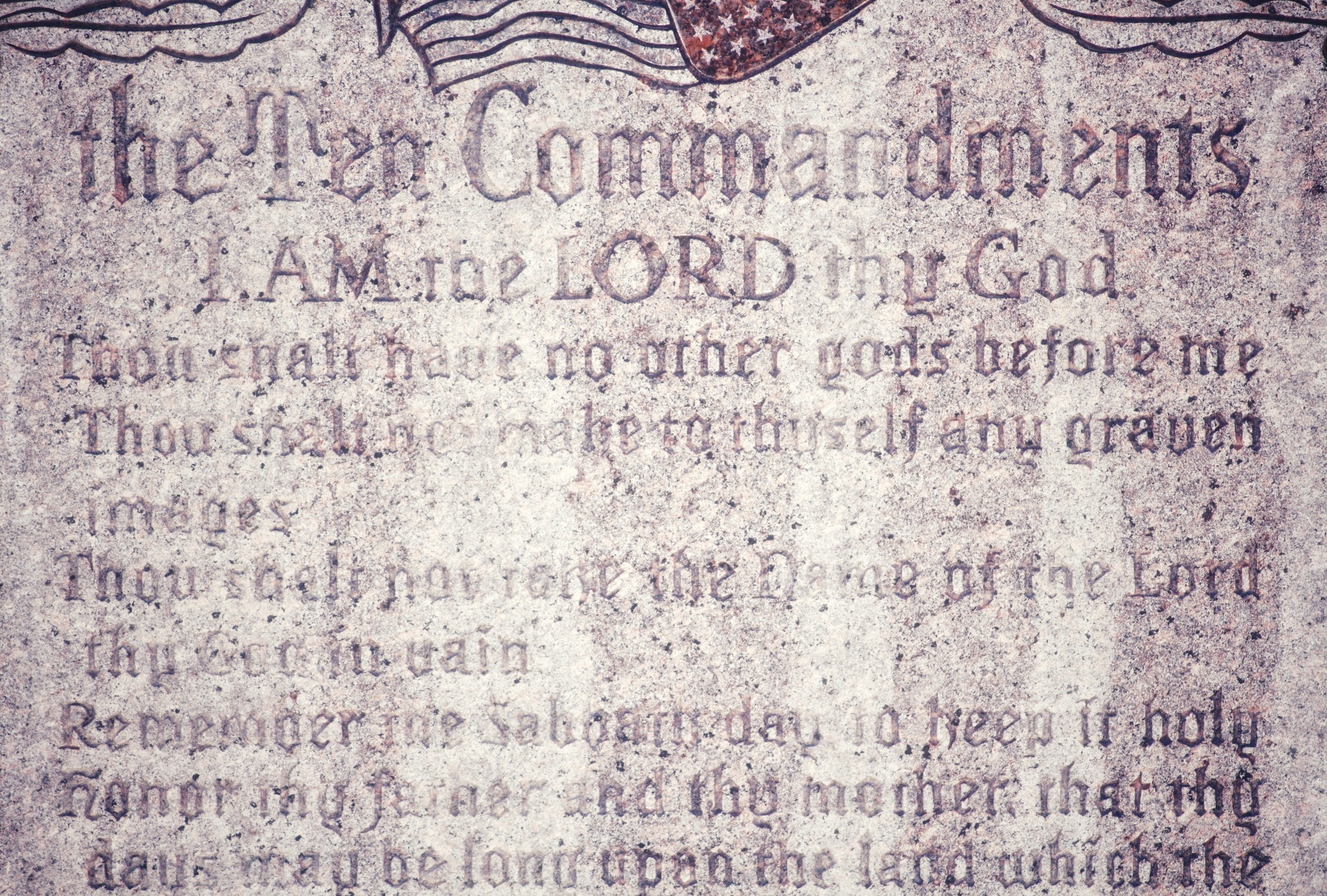
As CFI stated when the bill was initially signed into law, this unconstitutional measure “is an exclusionary, heavy-handed measure that will make every student who is a member of a minority religion (or no religion at all) feel like an outsider in their own school.”
On December 12, the Center for Inquiry (CFI) filed an amicus brief to the United States Court of Appeals for the Fifth Circuit in the case of Roake v. Brumley, which challenges HB 71, the Louisiana statute passed in 2024 that requires public schools to permanently display the Ten Commandments in every classroom. The full brief can be found here.
As CFI stated when the bill was initially signed into law, this unconstitutional measure “is an exclusionary, heavy-handed measure that will make every student who is a member of a minority religion (or no religion at all) feel like an outsider in their own school.”
Thus far, federal courts have agreed that Louisiana’s law violates the Establishment Clause; first in the United States District Court and, earlier this year, by a three judge panel in the Fifth Circuit Court of Appeals. The state of Louisiana has asked the full Fifth Circuit to reconsider.
CFI’s amicus filing contends “HB 71 runs afoul of history and tradition to promote a distorted, nonsecular history that alienates atheist students.” The brief offers a detailed history of how secular principles influenced the creation and ratification of the First Amendment and highlights the lengthy history of Supreme Court rulings that affirm the Establishment Clause’s protection ot atheists and nonbelievers’s rights.
“Forcing students to accept a distorted narrative that the history of their state and nation is rooted in religious tenets undermines intellectual integrity and inflicts harm on students with diverging beliefs,” CFI argues.
“For atheist children, this state-sanctioned messaging communicates, falsely, that their worldview is incompatible with foundational community values. The Establishment Clause was designed precisely to prevent this kind of governmental imposition of religious orthodoxy, ensuring that public education remains a neutral space where students of all faiths—and of none—can learn without coercion or doctrinal pressure. By elevating this religious narrative as historical truth, HB 71 runs afoul of the Establishment Clause considering the provision’s original meaning and historical practices.”
In the end, the message and the expectation are clear: “CFI respectfully urges this Circuit to reaffirm that the First Amendment’s religion clauses protect all Americans—atheists and believers alike by holding that HB 71 is unconstitutional.” The United States Court of Appeals for the Fifth Circuit is scheduled to hear arguments in this case on January 20, 2026.
CFI Legal brings cases at the state and federal level where they work to eliminate scientific pseudoscience, uphold the rights of non-believers, and provide legal assistance for those in need. CFI Legal accomplishes these tasks by filing amicus briefs and lawsuits.
The Center for Inquiry (CFI) is a nonprofit educational, advocacy, and research organization headquartered in Amherst, New York, with executive offices in Washington, D.C. It is also home to the Richard Dawkins Foundation for Reason & Science, the Committee for Skeptical Inquiry, and the Council for Secular Humanism. The Center for Inquiry strives to foster a secular society based on reason, science, freedom of inquiry, and humanist values. Visit CFI on the web at www.centerforinquiry.org.
Join the conversation!