
Sports disability lawyers remain essential partners for our athletes, their programs, and even responsible insurers, negotiating the right blend of critical care, disability, and NIL-focused coverage so that if the worst happens on the field, the athlete’s future off the field is still protected.
Sports disability lawyers have become the point guards of the modern college sports insurance ecosystem, assisting our athletes and athletic departments to structure coverage that actually responds when a serious injury or critical illness derails a season or an entire career. In an arena dominated by name, image and likeness (NIL) rights and its subsequent incredible revenue streams, major insurance companies are also finally establishing an affordable presence, offering a variety of health, disability and financial protection for our athletes.
Let’s discuss how new data-driven insurance tools allow schools and collectives to structure policies that reward safer programs and better medical practices while preserving robust protection for our athletes. Furthermore, we’ll explore how sports disability lawyers can advise on the best coverage, help with tricky insurance applications, and litigate any wrongful delay or denial.
A New Landscape: NIL, House and Insurance Solutions
In June 2025, Judge Claudia Wilken of the Northern District of California approved the $2.8 billion House v. NCAA settlement, formalizing direct payments and clearer rules around NIL, dramatically raising the financial stakes for our college athletes and their institutions. Major global underwriters seem to understand what this decision means for the future of college athletics. Undoubtedly, NIL will continue to generate billions of dollars for schools and their players and permeate global sports culture. Where there’s commerce, insurance is bound to follow and solid affordable options are emerging.
For example, Zurich North America and Players Health kicked off 2026 with a unique Critical Injury Protection Insurance solution that protects NIL investments when a student-athlete misses a significant portion of a season due to injury.
Under this new solution, colleges and collectives can insure NIL contract payments made or owed when an athlete is injured in official play, practice, or training and misses roughly 40 percent or more of the season. A parallel iteration can also be structured to protect athletes themselves against loss of future NIL-related income, aligning closely with the athlete-first goals of those of us who do this work.
Zurich’s plan differs from Aflac’s broad, critical illness or accident plan, which was announced in 2024. Aflac marketed their retail-style program to our athletes and groups, including families, triggered by specified diagnoses and injuries such as fractures, dislocations and ligament tears, not by NIL contract obligations.
Ultimately, any athlete with a NIL endorsement can purchase both policies as supplements, and should consult their sports insurance disability lawyer on the options that will serve them best. Policy language is often negotiable and accurate application help is often necessary and extremely helpful to prevent material misrepresentations leading to rescissions.
Why Critical Care and Critical Injury Insurance Matter
Critical care insurance provides a lump sum benefit when an athlete sustains a significant but not necessarily career-ending injury such as major ligament tears, rotator cuff tears, or substantial muscle injuries that materially impact their ability to compete.
These policies are typically structured in tiers:
- high-grade ligament or rotator cuff tears requiring reconstructive surgery may trigger a $250,000 benefit,
- serious muscular injuries such as torn triceps or pectorals may pay $100,000,
and
- spinal disc injuries may fall into a lower tier, approximately $50,000.
The lump sum can be used to cover deductibles and uncovered medical expenses, secure private specialists, fund intensive rehabilitation, or replace lost NIL income during recovery so an athlete is not forced to lean solely on family support, scholarships, or short-term loans. For generally healthy college players, these policies are relatively affordable, but the definitions, exclusions, and timelines for surgery or diagnosis are technical. In these scenarios, a sports disability lawyer’s insurance interpretation and negotiation skills are most valuable and often very necessary.
Integrating Critical Injury, Disability and NIL-Specific Coverage
In practice, critical care or critical injury insurance works best as part of a layered risk-management strategy. Key components include:
- Critical care / critical injury: Immediate lump-sum benefits after defined injuries, easing short-term financial shock and funding recovery.
- High-limit disability insurance: Monthly income replacement, often in the tens or hundreds of thousands of dollars, and millions for elite earners whose careers are interrupted or ended by injury or illness.
- Loss-of-value (LOV) riders: Permanent total disability policies with an LOV rider designed to pay if our athlete’s draft position or free-agency market value drops due to injury, helping replace lost expected professional contract earnings.
- NIL-focused coverage: Products like Zurich’s, which reimburse colleges or collectives for NIL obligations, and can be adapted to protect athletes’ future NIL revenue streams.
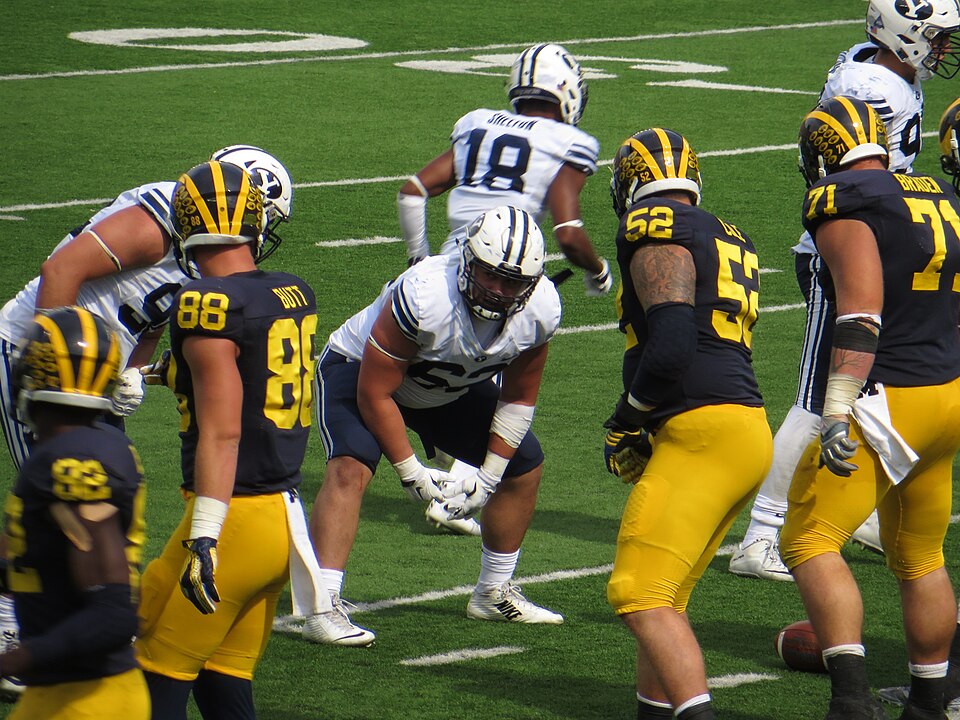
Michigan No. 88, Jake Butt, All-American Tight End, BYU Cougars vs. Michigan Wolverines, Michigan Stadium, University of Michigan, Ann Arbor, Michigan. Image by Ken Lund, CC BY-SA 2.0, via Wikimedia Commons, no changes made.
Let’s consider an actual scenario demonstrating how these tools work. Former Michigan tight end Jake Butt slipped to the fifth round in the NFL draft in 2017 after a late college ACL tear. This exemplified the value of LOV coverage, with Butt having reportedly recovered a six-figure benefit to offset the lower draft position and contract value.
Sports disability lawyers in this environment help ensure policy definitions match the athlete’s actual risk profile position and projected draft status. NIL portfolio and the athlete’s NIL-oriented coverages dovetail with traditional disability and LOV riders attached to permanent total disability policies rather than leaving huge gaps and serious financial risks.
Institutional Coverage: NCAA Programs and Emerging Gaps
At the institutional level, NCAA sponsored and school based programs form the backbone of catastrophic protection, but they were never designed to replace tailored critical injury coverage. Important pillars include:
- NCAA Catastrophic Injury Insurance: Excess medical expense insurance coverage that attaches once covered medical costs exceed a $90,000 deductible, for serious but not necessarily career-ending injuries sustained in covered intercollegiate activities.
- Post-Eligibility Insurance (PEI): A newer NCAA program providing up to $90,000 per injury for up to two years after a student-athlete’s eligibility ends, supplementing but not replacing primary and secondary coverage.
- Exceptional Student-Athlete Disability Insurance (ESDI): Voluntary, high-limit permanent total disability coverage, often in the $1-to-10 million range, for top professional prospects in high revenue sports.
The NCAA has also allowed Division I schools to fund athletes’ injury insurance out of their operating budgets, a move that can more importantly broaden access to critical care, permanent total disability, and LOV riders when wise administrators choose to invest in those protections.
The Need for Sports Disability Lawyers at the Intersection of NIL and Insurance
The bottom line is that athletes and athletic departments face a dense web of clear as mud policies, exclusions, tricky applications, deductibles, and overlapping responsibilities. Sports disability lawyers with seasoned experience in NIL and insurance placement are uniquely positioned to:
- Assist and consult with existing schools on NIL-related coverages to identify gaps between catastrophic, basic health, critical care, disability, and NIL-specific policies.
- Negotiate individual and group critical injury and straight disability, permanent total career ending coverage and drop in slot LOV riders that track the athlete’s projected income and not just current scholarship value.
- Align NIL contracts with Zurich-Players Health-style protections, ensuring that if a season disrupting injury occurs, athletes’ financial expectations and schools’ obligations are both realistically and fairly addressed and the school and player are paid timely and in good faith.
Sports disability lawyers remain essential partners for our athletes, their programs, and even responsible insurers, negotiating the right blend of critical care, disability, and NIL-focused coverage so that if the worst happens on the field, the athlete’s future off the field is still protected.
Join the conversation!