

In the courtroom, an act of physical contact is never just a simple action; it is an event judged by its context and consequences.
An argument in a crowded parking lot gets heated. Voices rise, tempers flare, and one person shoves another. In the eyes of the law, that simple, impulsive push is not just a disagreement—it’s an act of battery. The term often conjures images of brutal fights, but its legal definition is far broader, encompassing any intentional and non-consensual physical contact deemed harmful or offensive. The line between a minor offense and a life-altering felony is not drawn arbitrarily. It is defined by a surprisingly specific set of circumstances that examine the intent behind the touch, the harm it caused, and the identity of the person who was touched.
Defining Battery: The Core Elements of Unlawful Contact
At its heart, the criminal offense of battery rests on two foundational pillars: the act was intentional, and the contact was harmful or offensive to the other person without their consent. While these principles are broadly applied, the precise language in local statutes, such as those defining Georgia battery in Gainesville, GA, law, specifies what constitutes “insulting or provoking” physical contact.
To successfully prosecute a battery charge, the state must typically prove the following six elements:
- Intentional Action: The contact cannot be accidental. The defendant must have intended to make contact with the person.
- Actual Physical Contact: Unlike assault (which is the threat of harm), battery requires that physical contact actually occurred.
- Lack of Consent: The person who was touched did not permit the physical contact to happen.
- Harmful or Offensive Nature: The contact must result in either physical harm or be of a nature that is considered insulting, provoking, or offensive to a reasonable person.
- No Visible Injury Required: A charge can be sustained even if the contact leaves no mark. An unwanted, aggressive touch or spitting can qualify.
- Violation of Personal Autonomy: The core of the offense is the non-consensual violation of another person’s body or an object intimately connected to them.
It’s crucial to distinguish battery from assault; assault is the act of creating a fear of imminent contact, while battery is the contact itself. For this reason, a person can be charged with assault for swinging a fist and missing, but the charge becomes battery the moment the fist connects. This distinction is important because the harm doesn’t need to cause a visible injury. An aggressive poke in the chest or spitting on someone are both acts that can legally qualify as battery because they are offensive and violate a person’s physical autonomy, regardless of whether they leave a mark. The core of the offense is the intentional, unwanted violation of personal space.
The Misdemeanor Threshold: When Battery is a Lesser Offense
When an act of battery is classified as a misdemeanor, it is often referred to as “simple battery.” This charge typically applies when the encounter lacks what the law considers aggravating factors. The contact may have been offensive or even caused minor harm—like scratches, redness, or bruising—but it did not result in serious injury, involve a deadly weapon, or target a specially protected individual. Common scenarios include a heated family argument that turns into a shoving match, a slap during a confrontation, or a bar scuffle where punches are thrown but no one is seriously hurt. While a misdemeanor is a lesser offense, the penalties can still be disruptive. Convictions often lead to fines, probation, court-ordered anger management classes, and a jail sentence of up to one year. A permanent criminal record can impact employment and housing opportunities for years to come, which is why anyone facing this charge should consult with a Gainesville criminal lawyer to navigate the legal system and build a strong defense.
Key Aggravating Factors: Injury and Criminal Intent
The legal landscape shifts dramatically when certain aggravating factors are present, and the severity of the victim’s injuries is one of the most significant. A simple push is one thing, but an attack that results in “great bodily harm” or “serious bodily injury” will almost certainly lead to a felony charge. These terms refer to injuries that are more than just superficial, such as broken bones, deep cuts requiring stitches, a concussion, or any permanent disfigurement. Furthermore, some actions are considered so dangerous that they automatically escalate the charge; for example, battery by strangulation is often a felony because of its high potential for causing death.
The following table analyzes these key charge escalators:
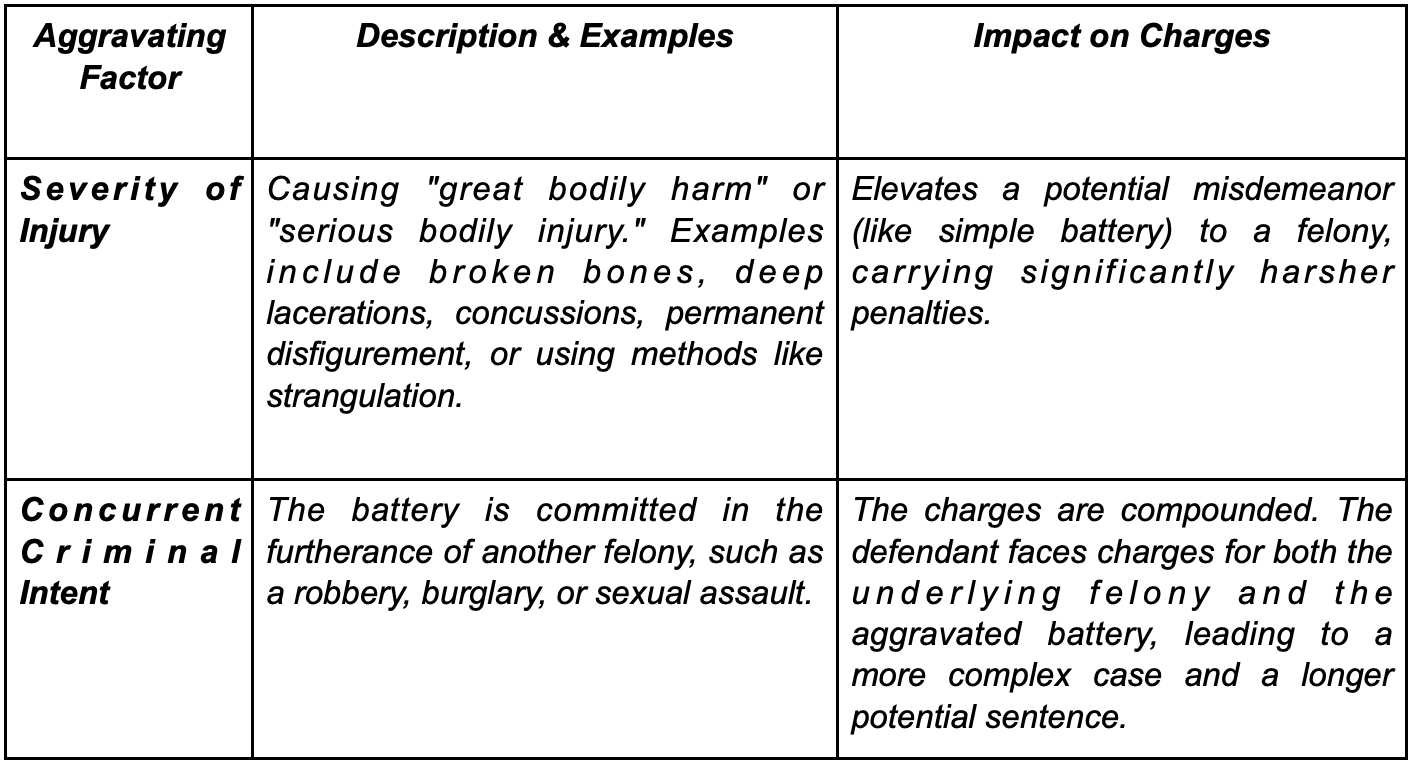
Another powerful escalator is the defendant’s intent to commit another crime. If the battery occurs during another felony, the charges compound. For instance, shoving a homeowner while burglarizing their house elevates the entire event, creating a complex legal challenge that a theft crimes attorney in Gainesville would be needed to properly address.
When Battery Turns Fatal: The Gravest Consequences
The most tragic and severe outcome of a physical altercation is when the act of battery leads to the victim’s death. When this happens, the charges escalate from battery to homicide, but the specific charge depends heavily on the circumstances and the defendant’s intent.
The determination of whether the charge will be manslaughter or murder hinges on a careful analysis of the entire incident. Prosecutors will examine several key factors to build their case, including:
- The Defendant’s Intent: Was there a clear intent to kill, an intent to cause serious harm, or was the death a completely unintentional accident?
- The Nature of the Initial Act: Did the death result from a misdemeanor act (like a simple push, potentially leading to manslaughter) or a felony act (like an armed robbery, which could trigger a felony murder charge)?
- The Level of Force Used: A single punch that leads to a fatal fall is viewed very differently from a sustained, brutal beating.
- The Use of a Weapon: Introducing a deadly weapon into the altercation almost always elevates the potential charge to murder.
- Evidence of “Depraved Indifference”: Did the defendant’s actions demonstrate a reckless and conscious disregard for the value of human life, even if killing wasn’t the specific goal?
- The Victim’s Status: In some jurisdictions, an attack on a law enforcement officer or other protected official that results in death carries enhanced penalties.
If a death occurs unintentionally during a misdemeanor act—for example, a single punch in a bar fight causes someone to fall, hit their head, and die—the charge may be involuntary manslaughter. However, if the death results from a felonious battery, such as a brutal beating with a weapon or an attack on a police officer, the charge could become second-degree murder or even felony murder.
Conclusion
In the courtroom, an act of physical contact is never just a simple action; it is an event judged by its context and consequences. The path from a misdemeanor to a felony battery charge is paved with specific aggravating factors—the degree of harm, the presence of a weapon, the victim’s protected status, or the link to another serious crime. What one person might dismiss as a minor scuffle, the law can define as a life-altering felony. The distinction underscores a critical legal principle: the circumstances surrounding an offense are just as important as the offense itself, determining whether the outcome is a manageable legal problem or a catastrophic blow to one’s freedom and future.
Join the conversation!