
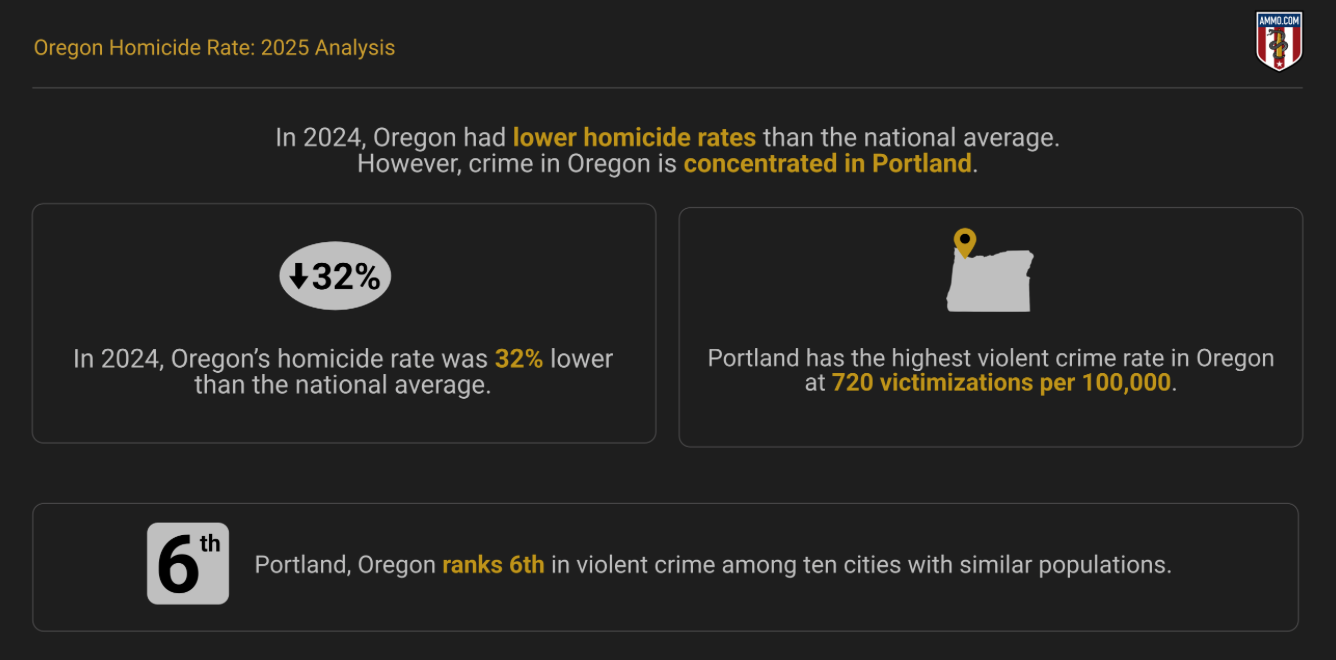
Although Oregon is one of the safest states in the U.S., Portland has a high concentration of violent crime (including homicides).
Report Highlights: In 2024, Oregon had lower homicide rates than the national average. However, crime in Oregon is concentrated in Portland.
- In 2024, Oregon’s homicide rate was 32% lower than the national average.
- Portland has the highest violent crime rate in Oregon at 720 victimizations per 100,000.
- Portland, Oregon ranks 6th in violent crime among ten cities with similar populations.
Methodology
Data in this report is sourced from the CDC WONDER Database and FBI Crime Data Explorer. The WONDER Database was used to retrieve state and national homicide rates, while the FBI Crime Database was used to retrieve city-level data.
This analysis compares Portland’s violent crime rates (which include homicide) to other intrastate and interstate cities using FBI data, and Oregon to states with similar policies (e.g. sanctuary vs. non-sanctuary states) and similar population sizes using the WONDER Database.
Homicide rates include justifiable homicides, and were compared using unweighted state-level averages. Each state contributes equally to the category totals, whether classified as a sanctuary or non-sanctuary state.
Oregon Homicide Rates
Oregon consistently reports lower homicide rates than the national average. In 2024, the state’s homicide rate was 32% lower than the national average.
Oregon Murder Rate Per Capita
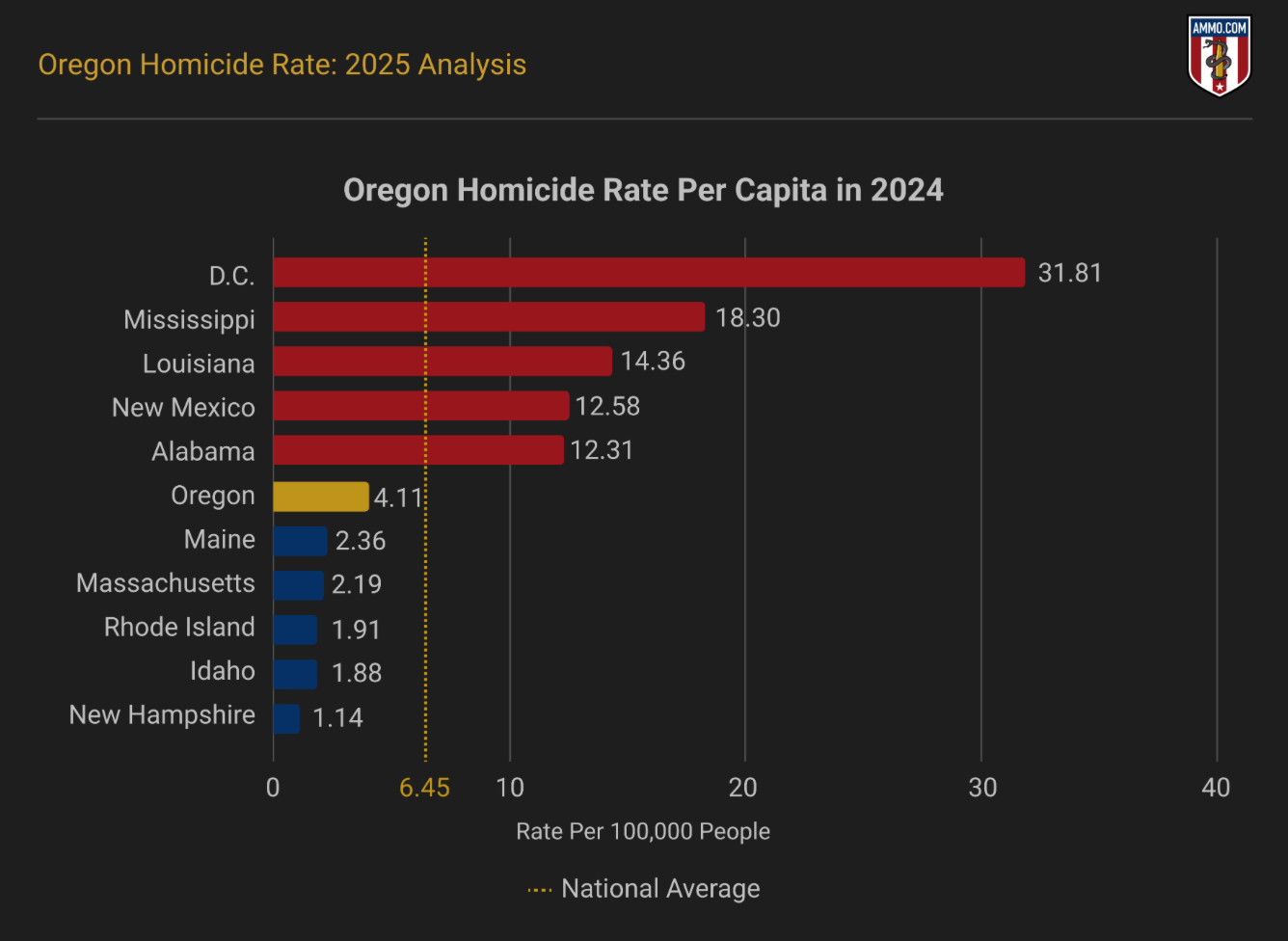
Oregon’s homicide rate increased in the 1970s and 1980s, with the highest homicide rate occurring in 1986 (6.6 per 100,000 people). In 2024, Oregon ranked 37th for homicides in the U.S. at 4.1 per 100,000, with 174 total murders reported to the CDC. (Source 2, 3, 4)
Comparatively speaking, New Hampshire had the lowest homicide rate in 2024, followed by Idaho, Rhode Island, Massachusetts, and Maine (below 2.4 per 100,000). Washington, D.C., Mississippi, Louisiana, New Mexico, and Alabama rounded out the top five states with the highest homicide rates that same year.
Oregon Homicide Rates by Year
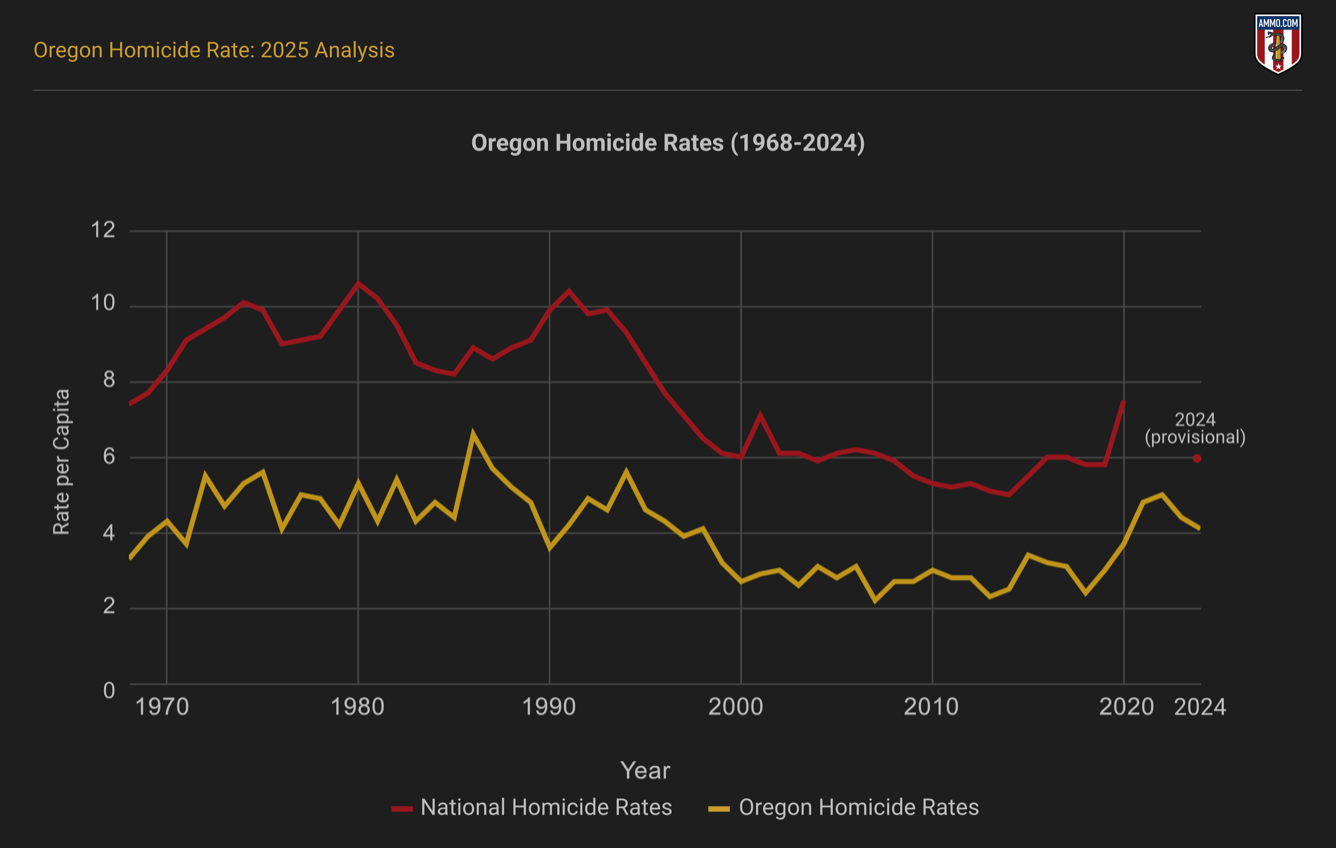
Although fluctuating over the past five decades, long-term trends show that Oregon’s homicide rates remain relatively low and stable compared to national patterns. Between the 1960s and 1990s, Oregon’s homicide rates ranged from 3 to 5 per 100,000 residents. (Source 2, 3, 4)
The state’s homicides remained low between 2000 and 2014, with rates between 2 and 3 per 100,000. They then rose during the COVID-19 pandemic, which aligns with national averages.
In 2024, Oregon’s homicide rate was 36.7% higher than pre-pandemic levels; the national rate, 3.45% higher.
Oregon Murder Rate Compared to Other States
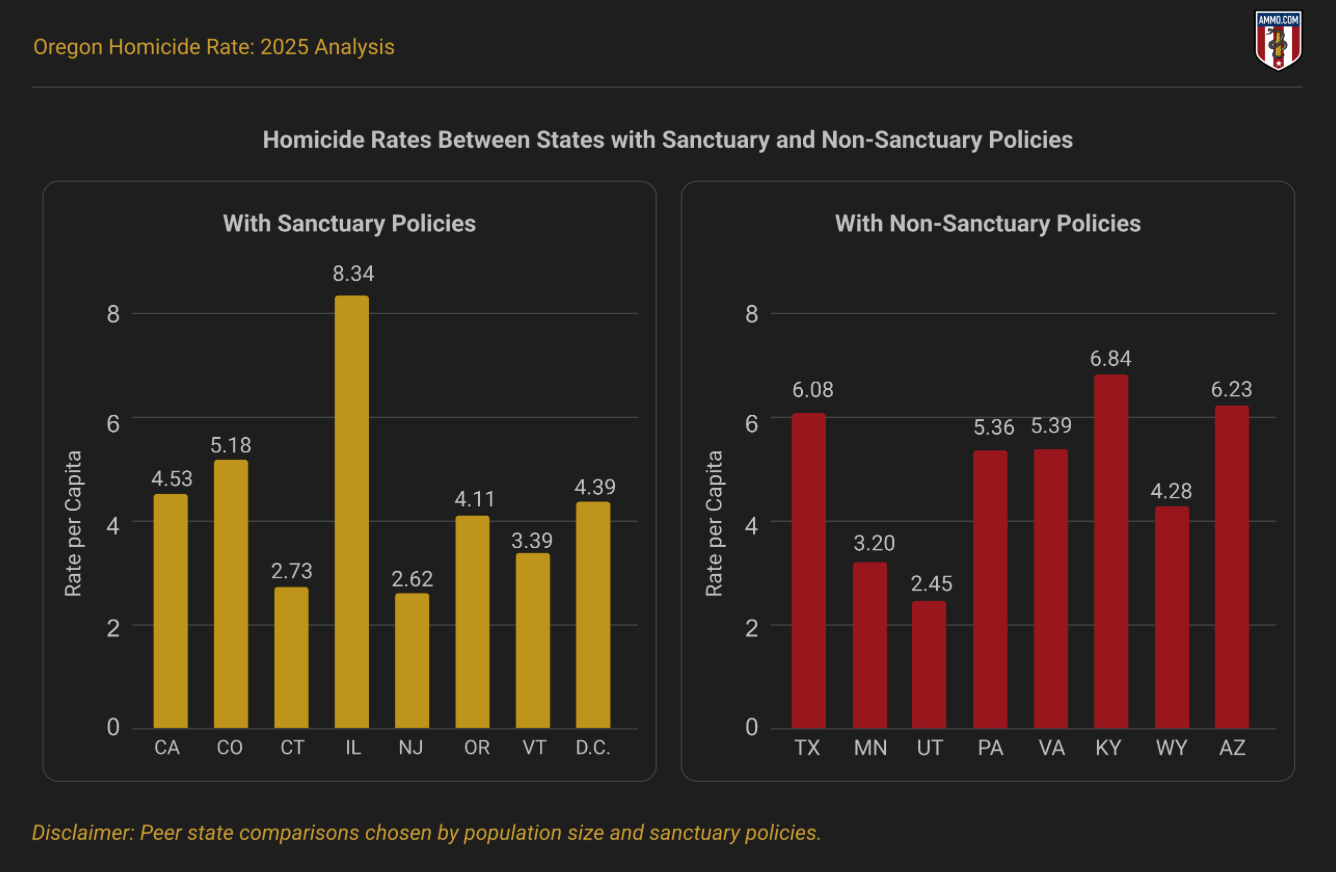
Oregon’s 2024 homicide rate remained below the national average (6.0 per 100,000 people) at 4.1 per 100,000, and aligned closely with nearby states including Washington (4.4 per 100,000) and Colorado (5.2 per 100,000).(Source 2, 3, 4)
Compared to other sanctuary states, including California (4.5 per 100,000) and Illinois (8.3 per 100,000), Oregon continues to report lower homicide rates. Oregon also has lower rates compared to non-sanctuary states such as Kentucky (6.8 per 100,000) and Arizona (6.2 per 100,000), yet higher rates than Utah (2.5 per 100,000).
Similar to the rest of the United States, Oregon experienced a sharp increase in homicides during the COVID-19 pandemic (46.7%), followed by a gradual decline. The state’s homicide rate fell by 6% between 2023 and 2024, while comparable states exhibited steeper declines.
Homicide Rates by Oregon Cities
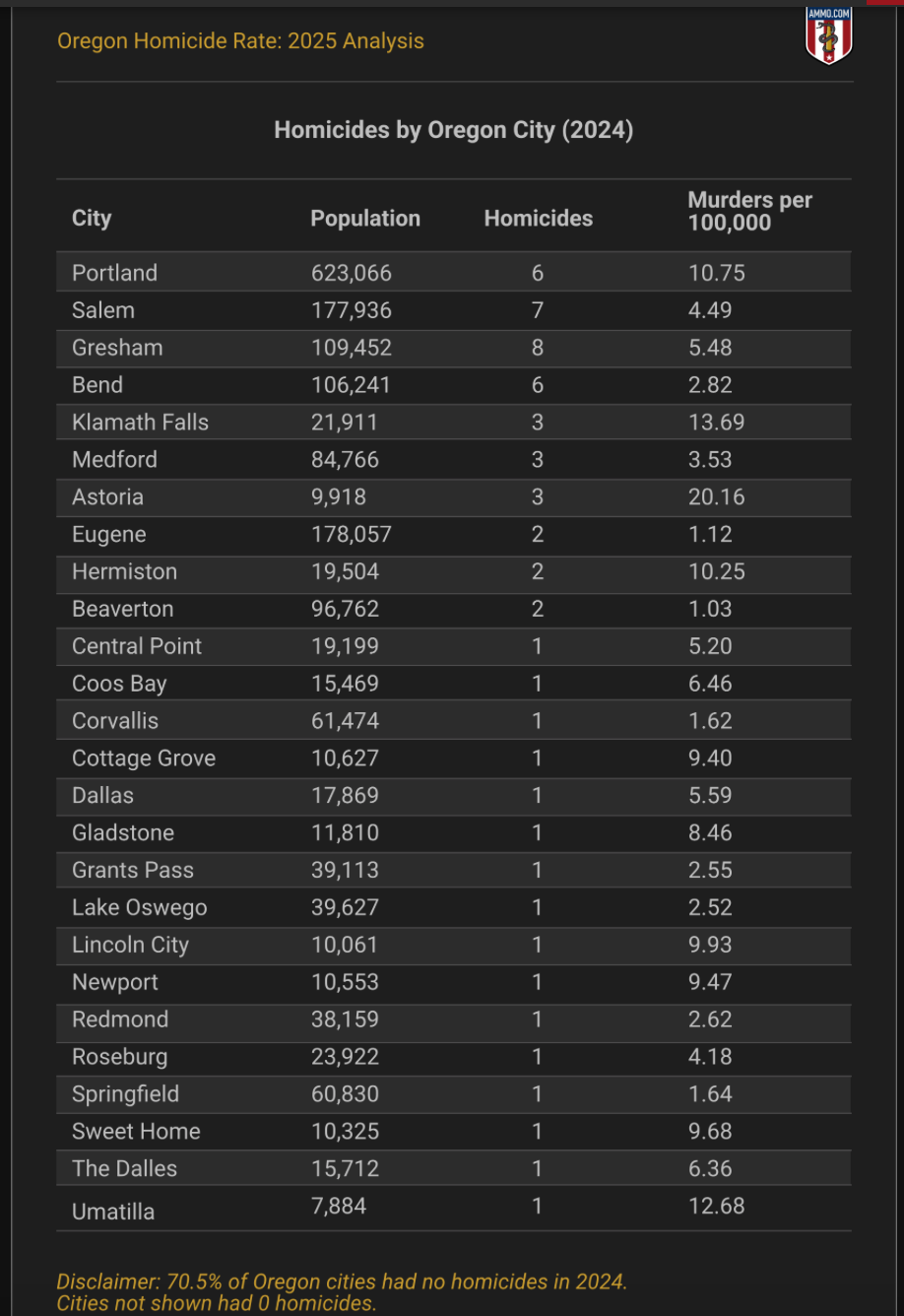
With a concentration of violence in the city, Portland’s homicide rate in 2024 was 10.8 per 100,000. Similar patterns arise when we compare only homicides across the state. Homicide data shows a similar concentration of violence in Portland. Of the 149 homicides reported to the FBI in 2024, 45% (67) happened in Portland, yielding a rate of 10.8 homicides per 100,000 people.
Although Astoria (20.17 per 100,000 people) and Umatilla (12.68 per 100,000) show higher homicide rates than Portland, these cities experienced 2 two and 1 one homicides in 2024, respectively. Salem (4.5 per 100,000), Gresham (5.5 per 100,000), and Medford (3.5 per 100,000) have homicide rates of less than half of Portland’s, while having more murders in 2024 than other Oregon cities.
Portland reported the most violent crimes in Oregon in 2024 (4,487). This equates to 720 victimizations per 100,000 people: more than double the statewide average (237.57 per 100,000).(Source 1)
Salem and Medford have lower violent crime rates than Portland – but higher than others, with violent crime rates of 532 and 492 per 100,000, respectively. Smaller cities such as Eugene (318 per 100,000), Hillsboro (318 per 100,000), and Beaverton (365 per 100,000) also have violent crime rates above the state’s average.
How Does Portland Compare to Similar Cities?
According to the FBI, Portland ranks 6th for violent crime among 10 of its peer cities (i.e. cities with similar population sizes).(Source 1)
Memphis, TN is the most dangerous of these 10, with 2,501.28 victimizations per 100,000 people. Detroit, MI, Baltimore, MD, Milwaukee, WI, and Albuquerque, NM round out the top 5, while Portland has more violent crimes than Louisville, KY, Boston, MA, Tucson, AZ, and El Paso, TX.

Wrap-Up
Although Oregon is one of the safest states in the U.S., Portland has a high concentration of violent crime (including homicides). Compared to other states with similar population sizes, sanctuary status has no impact on homicide rates. Furthermore, interstate comparisons of other cities show no direct causal link between immigration policy and violent crime.
Sources:
- FBI Crime Data Explorer
- National Center for Health Statistics Mortality Data on CDC WONDER
- CDC WONDER Underlying Cause of Death by Bridged Race Categories
- CDC WONDER Underlying Cause of Death 2018-2023
- CDC Provisional Mortality Statistics
LegalReader thanks our friends at Ammo.com for permission to republish this piece. The original is found here.
Join the conversation!