
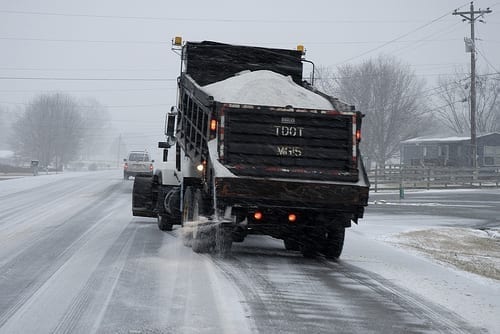
Driving around large trucks and simultaneously dealing with challenging winter road conditions can be tricky.
Sharing the road with commercial vehicles can be a daunting experience. A fully-laden semi-truck can weigh up to 80,000 pounds, which is more than sixteen times as heavy as the average passenger vehicle. In almost any scenario where a passenger vehicle is involved in a crash with a truck, the smaller vehicle will come out worse for wear.
Although there is no way to entirely eliminate the chance of a car crash happening, there are strategies you can use to protect yourself and your passengers on the road. In this article, we discuss some safety tips to avoid preventable crashes with commercial trucks during the winter months.
Stay Out of a Truck’s Blind Spots
One of the simplest things you can do to reduce your chance of being hit by a truck is to avoid their blind spots. Commercial vehicles have significantly larger blind spots (or “no zones”) than passenger vehicles. Truckers cannot see the spaces directly behind or adjacent to their vehicles, and their visibility over the hood is limited as well. A good rule of thumb is that if you cannot see the trucker in their side mirrors, they can’t see your vehicle either!
Make the trucker’s life easier by ensuring you are easy to spot when alongside, behind, or directly in front of a commercial vehicle. Doing so reduces the chance of the truck merging into the side of your vehicle or rear-ending you.
Only Pass When It’s Safe to Do So
This tip may seem self-explanatory, but it’s easy to make a critical mistake when overtaking a large vehicle, especially if you’re a newer driver. When you want to pass a truck, begin by making sure you can see the driver in their side mirror before proceeding. When it comes time to pass, change lanes to your left and pass quickly. You don’t want to slowly overtake a large vehicle, since you may become lost in the truck’s blind spot if they lose sight of your car. You should not pass from the right-hand lane.
Don’t Cut Off or Tailgate Commercial Vehicles
You should never cut off or tailgate vehicles on the road, or indulge in any other type of road rage when behind the wheel. However, it’s especially important to not get into a battle of wills with a vehicle that weighs forty tons!
As mentioned in this article, truck drivers have limited visibility directly in front of their vehicle. If you wait until the last second to change lanes and merge right in front of a truck, the driver may not see you and run right into your car.
Similarly, a truck driver won’t be able to see you if you’re directly behind them. At the same time, you won’t be able to see roadway hazards or traffic slow-downs coming up in front of you. If the truck driver needs to take evasive action or slam on the brakes, you could crash right into the back of their vehicle and suffer serious injuries.
Adjust Your Driving for Road Conditions
Especially in the winter, it’s crucial to adjust your driving habits to reflect weather and traffic conditions. You should:
- Prepare your car for winter by testing your battery, equipping winter tires, checking your wiper blades and replacing if needed, and keeping your gas tank at least half full so the gas line doesn’t freeze.
- Adjust your speed to account for road conditions, even if that means driving below the posted speed limit.
- Increasing your following distance to account for effective braking or emergency maneuvers.
If you find yourself driving during a whiteout that severely restricts your visibility, pull off the road at a safe location and wait for conditions to improve. Unless there is an emergency, do not pull off on the shoulders. Other drivers may attempt to do the same thing and hit your vehicle.
Stay Focused on the Road

Even the most careful driver can be distracted by talkative passengers, their vehicle’s radio or other components, or even something happening on the side of the road. No matter what, make sure you are devoting your full attention to what’s happening in and around your vehicle. By staying alert to the movements of other drivers and commercial vehicles, you can react to potentially dangerous situations quickly enough to avoid a crash.
Never Drive While Fatigued
Driving while fatigued is actually one of the most common causes of preventable wrecks. According to the Occupational Safety and Health Administration (OSHA), drowsy driving “is comparable to impaired driving.” After a long enough time without proper rest, a driver’s reaction time and control over their vehicle is significantly decreased. Fatigue can cause a driver to:
- Temporarily fall asleep behind the wheel
- React more slowly to other drivers, pedestrians, or road conditions
- Make unsafe driving decisions
- Drift into an adjacent lane or median
- Forget what has happened over the past few miles driven
Protect Yourself While Behind the Wheel This Winter
Driving around large trucks and simultaneously dealing with challenging winter road conditions can be tricky. Fortunately, by making sure your car is adequately prepared for the cold and driving defensively, you can protect yourself and your passengers. We hope this article helps you enjoy your time spent driving during this year’s holiday season!
Join the conversation!