

By lifting statutes of limitations, lawmakers are recognizing the profound obstacles that have been preventing survivors from being heard.
A wave of new bills for “lookback windows” in states such as California and New York is providing thousands of survivors with hope. They may be able to file abuse claims for cases with expired statutes of limitations.
What Are Lookback Windows?
Statutes of limitations are state mandates limiting the time you can bring an action against an alleged offender. Generally, these are strict deadlines that must be met, and that can be a problem in some cases, such as child or sexual abuse. Most young, traumatized victims are often not in a situation to take action. It also doesn’t help that the perpetrators are often people they knew, family members or friends, and institutions they trusted and respected.
“Lookback window” (also called “revival window”) laws temporarily lift the statutes of limitations, sometimes for just a few months. A civil suit may be filed by the survivors against the perpetrators if swift action is taken.
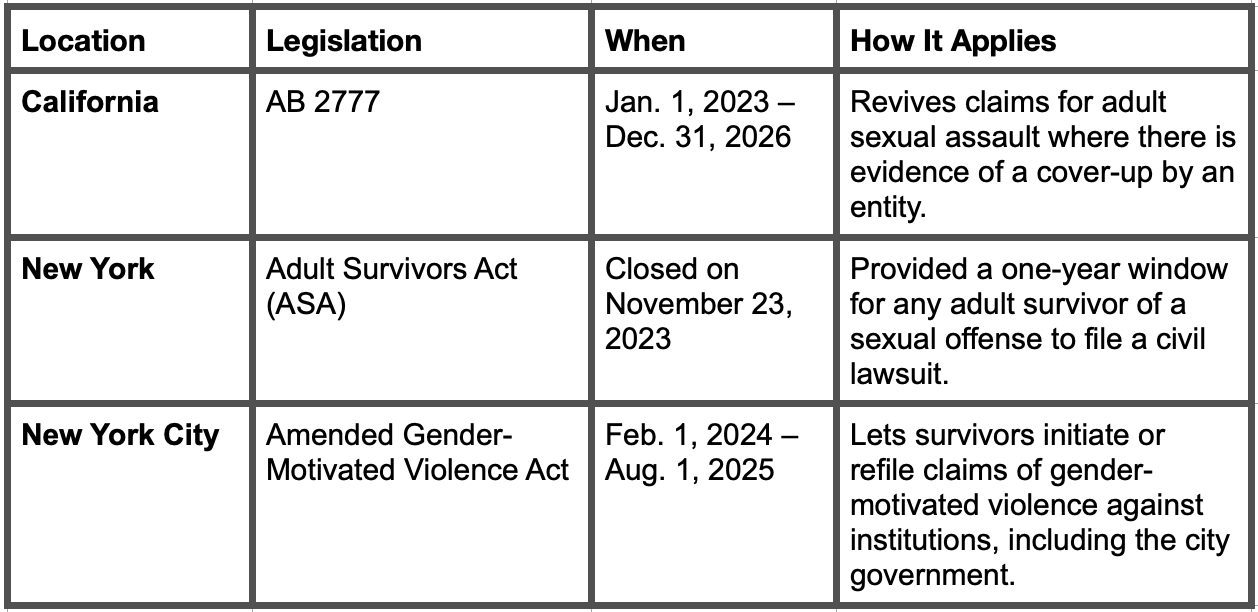
New York had the Adult Survivors Act (S.B. S66A), which allowed adult abuse survivors to file lawsuits, regardless of how long ago the abuse happened, until November 23, 2023. Thousands of lawsuits flooded in against institutions and individuals.
When the ASA window closed, New York City amended its Gender-Motivated Violence Act. It allowed victims to pursue claims of gender-motivated violence that happened within the five boroughs of New York City until February 28, 2025. These included cases that have already been dismissed, putting hundreds of lawsuits back in play. After that, victims of violent acts still had nine years from the time of the offense to file a case.
California has passed legislation of this type. Assembly Bill 218 was signed in 2020 and provided survivors of child sexual abuse claims against the public and private sectors with a 3-year window. AB 2777 also allows the same and postpones the final submission date for such claims until December 31, 2026. This specifically applies to adult survivors where proof exists of an institution’s attempt at cover-up of said claims.
These laws have not been without controversy. The flood of lawsuits under AB 218 has placed an enormous financial strain on public institutions. Driven by worry of potential payouts in the billions, county officials are pushing hard to reform these lookback window laws.
A Reckoning for Institutions: New Claims
These new statutes provide many survivors with the first chance for justice. Reporting often cannot occur immediately after a trauma, due to fear, trauma, and psychological impact on survivors. This fact is borne out by statistics showing the sheer number of time-barred claims. Statistics from RAINN state that two-thirds of all rapes are unreported to law enforcement, and lookback windows provide victims a way to hold offenders responsible.
What Lookback Window Legislation Enables
- The right of a party to bring a new tort action at law for recovery of damages, although the statute of limitations has run against the tort cause of action that initially accrued.
- The right to compensation in the form of monetary damages for injury to the extent it affects the remainder of their lives and will result in lifelong pain, suffering, and medical care (estimated lifetime cost of rape to the individual is $122,732).
- The right to sue not only the individual who committed the abusive act, but also the institution that may have permitted or covered it up.
- The right to have the transgressions officially recognized and recorded.
Faced with thousands of institutional abuse lawsuits, religions, private schools, youth organizations such as the Boy Scouts of America, and cities are facing crippling legal and financial damages and reputational losses.
And this shift toward greater institutional liability is occurring globally. The government of Victoria, Australia, recently passed landmark legislation that would make institutions liable for the acts of their agents, even where such an abuser is not an employee, and set aside prior settlements under the less restrictive laws.
State-by-State Legal Avenues and Deadlines
It is also very important for all victims/survivors to know that these statute-of-limitations lookback windows are only open until a specified date and time. Specific procedures that vary widely depending upon the state need to be followed prior to filing a claim, and the timing is paramount.
Statutes have been adopted in some states to permanently extend the statute of limitations on abuse actions. For instance, a Missouri Senate committee recently approved legislation that would remove the age deadline for childhood abuse survivors to file civil lawsuits, sending the measure to voters for approval.
For an interested party to pursue a civil suit for sexual assault, under the new legislation, it is usually an extensive procedure and can include many years of investigation and examination of occurrences that took place perhaps over many decades ago. For some survivors, knowing what to anticipate in a civil sexual assault lawsuit is a key component to seeking justice. An attorney knowledgeable in this area can guide survivors in taking advantage of these new causes of action and in operating within the parameters of state statutes regarding time and proof for the lookback period.
Accountability Revived
Lookback window laws signal a new era for historical abuse. By lifting statutes of limitations, lawmakers are recognizing the profound obstacles that have been preventing survivors from being heard until now and demanding accountability from powerful institutions.
However temporary the provisions may seem, they might well establish precedents for corporate and institutional liability in the years ahead. Once the old cases have been let out of the box, we shall see whether the system can cope, and indeed whether this is not a country-wide movement.
Join the conversation!