
To be clear, despite the misleading presence of storefronts, magic mushrooms remain federally illegal in Canada for general use.
In cities like Vancouver and Toronto, magic mushroom dispensaries operate with surprising openness, creating a public perception that psilocybin is legal. However, this is a dangerously misleading assumption. This confusion is set against the backdrop of a broader “psychedelic renaissance,” where growing research into psilocybin’s therapeutic benefits fuels public interest and calls for reform. The disconnect between public behavior and federal law is significant, as a 2023 report found that 5.9% of Canadians reported using psychedelics in 2023, a 195% increase since 2019.
This article will cut through the confusion to provide a clear explanation of Canadian federal law, detail the serious criminal penalties for possession and distribution, and clarify the narrow, legal exceptions for medical and research use. Understanding the law is the first step toward recognizing the considerable risks of participating in this unsanctioned market.
Canada’s Stance: Why Magic Mushrooms Remain Illegal
The core of the issue lies in the difference between federal law and municipal enforcement. While local police may deprioritize action against certain storefronts, this does not change the fact that magic mushrooms are illegal at the national level. This section establishes the legal foundation that all Canadians should understand.
A Schedule III Controlled Substance
Psilocybin and its active compound, psilocin, are classified as Schedule III controlled substances under Canada’s Controlled Drugs and Substances Act (CDSA). A Schedule III substance is defined as a drug with a potential for abuse that is illegal to possess, produce, or traffic without specific authorization from Health Canada. This federal law applies uniformly across all provinces and territories, meaning that no matter where you are in the country, the baseline legality of psilocybin remains the same: it is prohibited.
The Legal Disconnect: Federal Law vs. Municipal Presence
The existence of psilocybin dispensaries is a result of a “grey market” similar to the one that preceded nationwide cannabis legalization. These shops operate based on enforcement discretion, where local police departments may choose to allocate their resources to other public safety priorities. It is critical to understand that this is not a change in the law. Police can, and do, take action against these operations. A recent example is the RCMP seizure of psilocybin and other illicit substances in Nova Scotia, demonstrating that arrests and criminal charges for those operating outside the law remain a firm reality.
The Penalties vs. The Perception of Legality
For consumers, the perception of legality created by open dispensaries can be particularly hazardous. Participating in the grey market, whether as a buyer or a seller, carries substantial legal and personal safety risks. The criminal penalties are severe, and the products are completely unregulated.
Criminal Penalties Under the CDSA
The potential legal consequences for psilocybin-related offenses under the CDSA are significant and should not be underestimated. The penalties vary based on the specific crime.
- Possession: For a first offense, possession can be treated as a summary conviction, resulting in a fine of up to $1,000, imprisonment for up to six months, or both. For subsequent offenses or if prosecuted as an indictable offense, the penalties can increase substantially.
- Trafficking (including selling): This is a serious indictable offense that carries a maximum penalty of ten years in prison.
- Production (growing): Growing magic mushrooms is also an indictable offense, with penalties that can range up to a maximum of ten years in prison.
Unregulated Products vs. Authorized Medical Supply
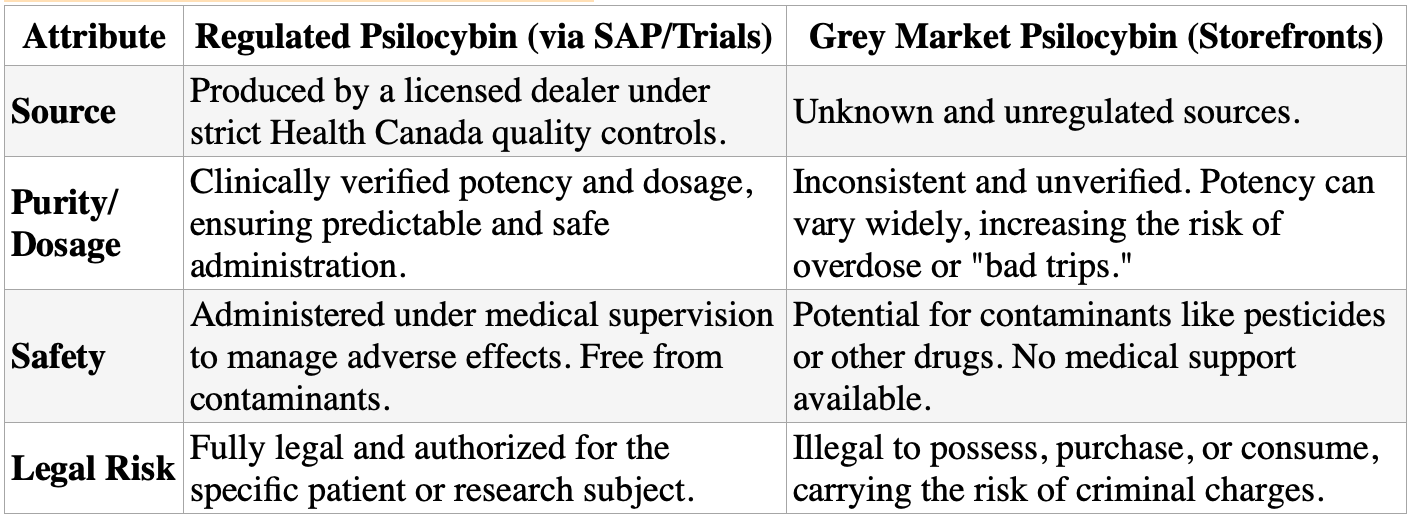
Beyond the legal jeopardy, consumers in the grey market face risks related to product safety. Unregulated psilocybin products sold in dispensaries have no oversight and can vary dangerously in purity, dosage, and may contain harmful contaminants. The difference between these products and a regulated medical supply is stark.
Medical and Research Use: Who Can Legally Access Psilocybin?
While general access is prohibited, the Canadian government has established very specific and limited pathways for legal access to psilocybin. These exceptions are strictly for medical and scientific purposes and are not available to the general public.
Health Canada’s Special Access Program (SAP)
Health Canada’s Special Access Program (SAP) allows physicians to request access to restricted drugs like psilocybin for patients with serious or life-threatening conditions where conventional treatments have failed. According to a 2024 report, as of February 2024, 176 Canadians had been authorized to access psilocybin through the SAP, with Health Canada approving 78% of applications. This demonstrates it is a viable, though highly restricted, pathway for patients in critical need under direct medical supervision.
Clinical Trials and Provincial Regulation
Psilocybin is also legally used in a small number of approved clinical trials across Canada, which are essential for gathering data on its safety and efficacy. A 2023 report noted four ongoing clinical trials in Canada investigating psilocybin for various mental health conditions. Furthermore, in January 2023, Alberta became the first province to regulate the medicinal use of psychedelics, allowing licensed psychiatrists to administer them to patients under specific protocols. These measures show a growing acceptance in medical circles, buoyed by strong public support; a 2021 survey showed 82% of Canadians approve of psilocybin therapy for end-of-life illness.
Expert Insight on Canadian Drug Law
With such a confusing mix of federal statutes, discretionary local enforcement, and shifting public opinion, understanding one’s rights and the real legal risks is critical. The line between a perceived “grey market” and a criminal offense is sharp, and a misunderstanding can lead to severe consequences. This is where specialized legal knowledge becomes indispensable.
Firms like Substance Law focus specifically on Canada’s complex and evolving drug laws. Their expertise provides much-needed clarity on the Controlled Drugs and Substances Act, helping individuals and businesses distinguish between illegal grey-market operations and the very narrow legal pathways for regulated substances. They offer an authoritative voice on what constitutes a criminal act versus an authorized exemption, ensuring clients are not misled by the visible but unsanctioned retail environment.
For anyone seeking a definitive understanding of psilocybin’s status or facing drug-related legal issues, it is vital to consult with experts who are deeply familiar with this niche area. For a comprehensive breakdown on this topic, Substance Law provides a detailed guide that addresses the issue of are magic mushrooms legal in Canada, offering further insights and support for navigating these challenging legal questions.
Clarity in the Haze: The Reality of Psilocybin Law in 2026
To be clear, despite the misleading presence of storefronts, magic mushrooms remain federally illegal in Canada for general use. The “grey market” exists not because of a change in law, but because of inconsistent local enforcement, and it carries significant legal and safety risks that consumers must not ignore. While the legal landscape is slowly evolving with programs like the SAP and pioneering provincial regulations in Alberta, these pathways are highly restricted, medically supervised, and do not signal a change in legality for the general public.
If you are facing charges related to a controlled substance or need to understand your legal standing, it is crucial to seek advice from an experienced legal professional. A qualified attorney can help you understand your rights and navigate the complexities of the Canadian justice system.
Join the conversation!