
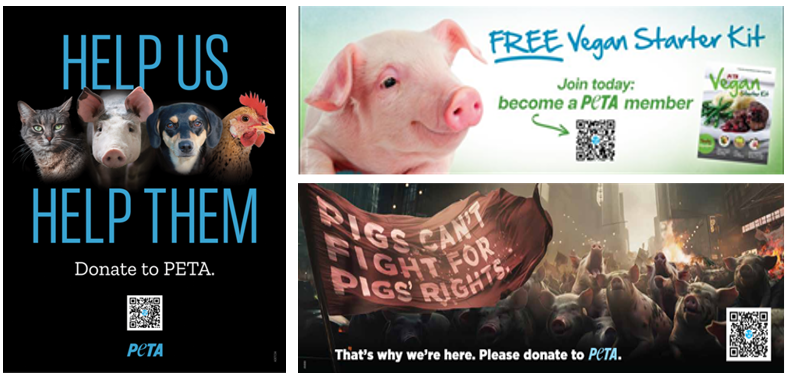
PETA’s lawsuit points out that WMATA’s advertising guidelines explicitly allow ads soliciting donations, and the agency has accepted similar ads from other nonprofit groups.
Washington — PETA has filed a lawsuit against Washington Metropolitan Area Transit Authority (WMATA) General Manager Randy Clarke in federal court alleging that WMATA’s refusal to run three non-graphic ads seeking donations for PETA constitutes illegal viewpoint discrimination and a violation of the First Amendment.
PETA’s lawsuit points out that WMATA’s advertising guidelines explicitly allow ads soliciting donations, and the agency has accepted similar ads from other nonprofit groups—yet when PETA submitted its ads for placement last year, WMATA’s agent Outfront claimed that they violated a guideline prohibiting ads “intended to influence members of the public regarding an issue on which there are varying opinions.” The lawsuit outlines that the rejected ads merely show images of animals alongside requests for donations and broad references to PETA’s mission—and that WMATA is unable to reasonably explain how they violate the guideline.
“Washington’s transit authority seems hell-bent on keeping PETA ads out of its metro system, even if it has to violate the law to do it,” says PETA Foundation General Counsel, Litigation Asher Smith. “PETA looks forward to establishing that WMATA’s rejection was unconstitutional and that PETA has the right to seek donations to support its mission of animal liberation.”
PETA previously sued WMATA in 2017, arguing that its advertising guidelines were unenforceable under the First Amendment because they were so vague that the acceptance or rejection of an ad was ultimately subject to the whims of the reviewer. PETA voluntarily dropped that lawsuit in 2025 after WMATA published new “interpretive aids” that appeared to provide more objective criteria for reviewers to apply when evaluating advertising applications. PETA’s current lawsuit argues that WMATA ignores its own interpretive aids for advertisers whose mission it disagrees with.
The lawsuit was filed in the United States District Court for the District of Columbia with the assistance of local counsel Matthew Strugar.
PETA—whose motto reads, “Animals are not ours to experiment on, eat, wear, use for entertainment, or abuse in any other way”— points out that Every Animal Is Someone and offers free Empathy Kits for people who need a lesson in kindness. For more information, please visit PETA.org or follow PETA on X, Facebook, or Instagram.
Join the conversation!